
6 Urgent Steps to Stop Powdery Mildew Before It Wipes Out Your Garden
One warm, dry afternoon is all it takes for invisible spores to jump from your squash to your roses across the yard. Here’s why it spreads so fast, and the 6 moves that actually shut it down.
Never miss an update — choose Garden Kindred as your preferred source on Google.
How it works: Tap the button below to open Google’s settings page, then check the box next to Garden Kindred.
Tap the checkbox to turn it blue — that’s how you know it’s set.
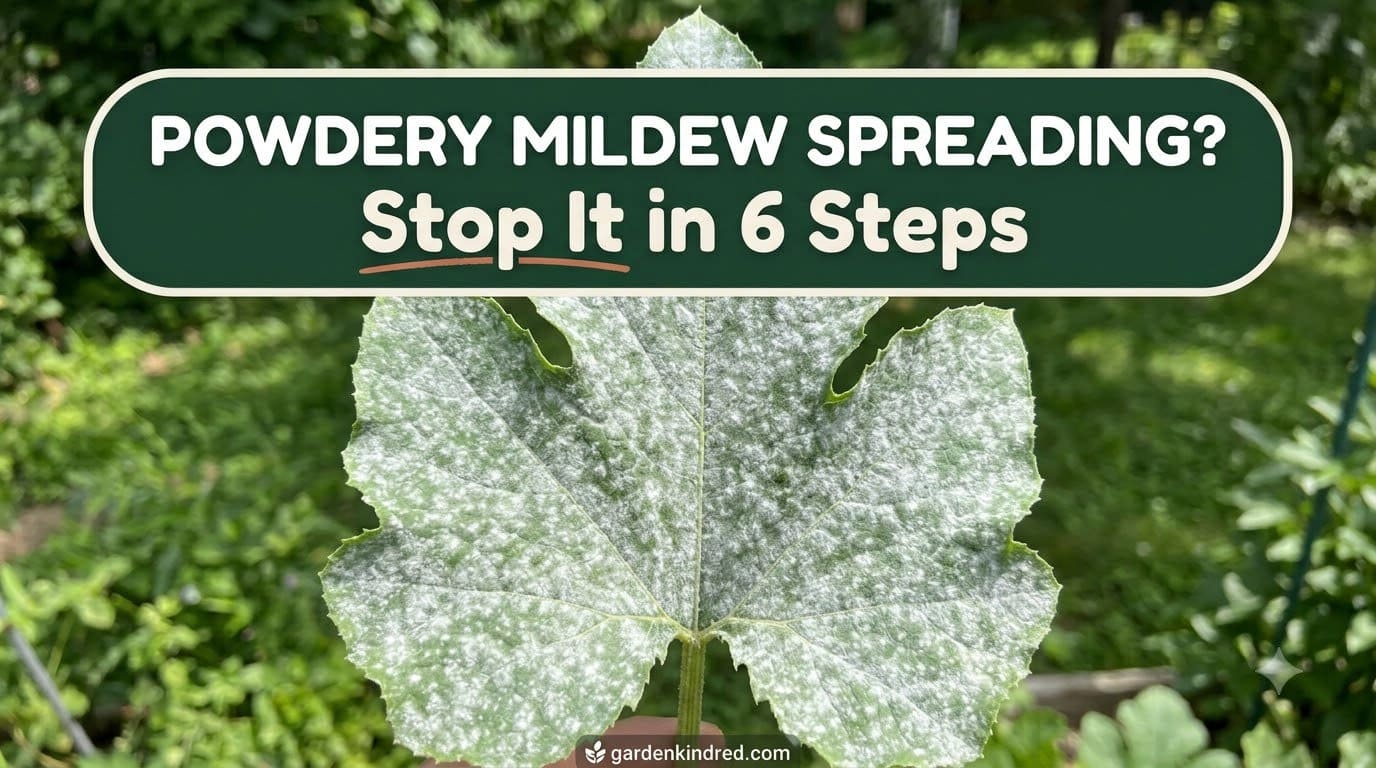
Powdery mildew is a fungal disease that spreads through airborne spores, not through soil or water contact, which is why it shows up on unrelated plants across a yard within days. The fungus (usually a species in the Erysiphaceae family) needs high humidity at night to produce spores and warm, dry days near 70 to 80°F to launch them into the air, according to Cornell’s Plant Pathology and Plant-Microbe Biology program. Stopping it means treating already-infected leaves with a contact fungicide, protecting healthy leaves with a different preventive product, fixing the airflow and watering habits that created the humidity swing in the first place, and removing infected debris so next year’s spore supply doesn’t start on your own property.
Powdery mildew does not care what you planted. Squash, roses, phlox, lilacs, zinnias, cucumbers, bee balm, and dozens of other unrelated species can all show the same white dusty coating within the same week, because the fungus that causes it is not one single pathogen tied to one crop. It is a whole family of closely related fungi (Erysiphaceae), and most of them are picky about their host but not picky about your yard, so a bad outbreak on your garden phlox and a bad outbreak on your zucchini in the same August are very often two completely separate infections that just showed up at the same time because the weather set up the same way for both.
That timing is not a coincidence, and understanding why matters more than any single spray, because the spray only works if you also fix the conditions that let the fungus keep making more spores.
What Is Powdery Mildew and Why Does It Spread So Fast?
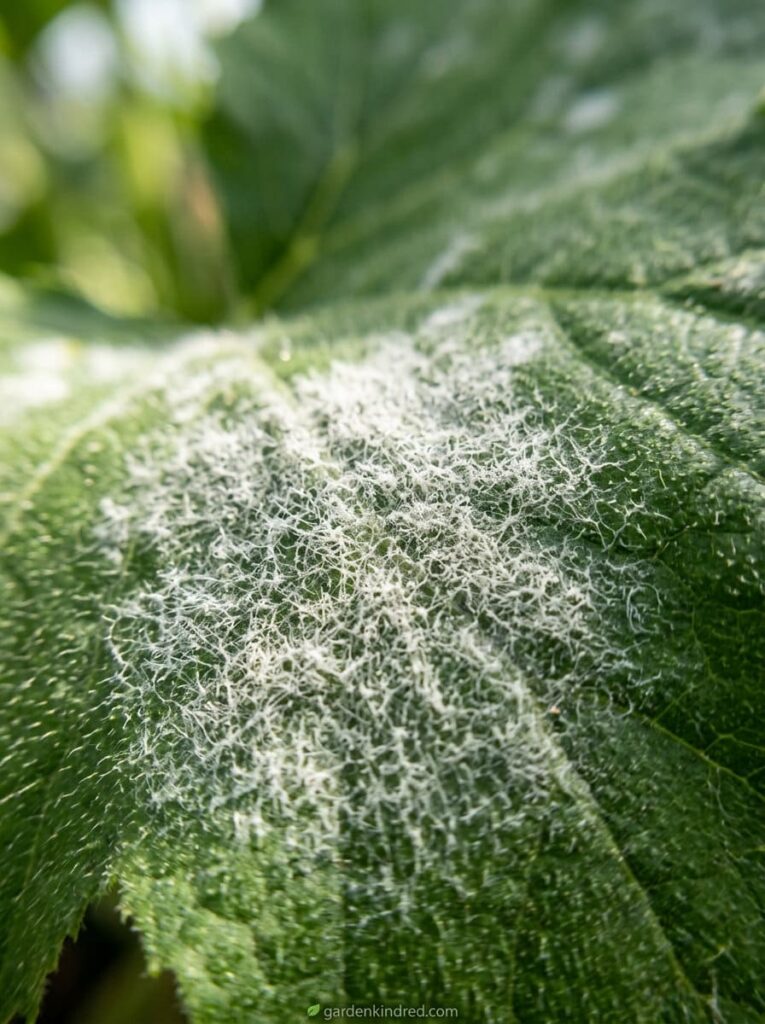
Powdery mildew is caused by obligate biotrophic fungi, meaning the fungus can only survive on living plant tissue and dies along with the leaf it colonizes. According to the University of Minnesota Extension, the fungus produces a mat of white mycelium on the leaf surface and sends tiny root-like structures called haustoria into the plant’s epidermal cells to pull out nutrients, without actually killing the cell right away. That is why an infected leaf can look dusted with flour for two or three weeks before it starts to yellow, curl, or drop.
The spread mechanism is the part most articles skip. Spores form in long chains standing straight up off the leaf surface, and wind knocks them loose the same way it knocks pollen off a ragweed plant. Colorado State University Extension notes that powdery mildew fungi are unusual among plant pathogens because they can germinate and infect a leaf with no free water present at all, and in some species standing water on the leaf actually kills the spore. That single fact explains almost every practical rule in this article: overhead watering that keeps leaves wet doesn’t cause powdery mildew and can even suppress it, while dry, still, humid air around the plant is the exact condition the fungus wants.
The temperature and humidity pattern that triggers the worst outbreaks is specific and repeatable. Cool, humid nights (roughly 60 to 70°F with high relative humidity) trigger heavy spore production, and the following warm, dry day (70 to 80°F) is when those spores actually launch and travel, per Cornell’s Plant Pathology and Plant-Microbe Biology program’s greenhouse and landscape disease guidance. That is why outbreaks cluster in late summer and early fall in most of the country, when nights start cooling faster than days do.
How Do You Tell Powdery Mildew Apart From Look-Alikes?
Misdiagnosis wastes an entire treatment cycle, and it happens constantly because three or four different problems produce a similar-looking white or gray film.
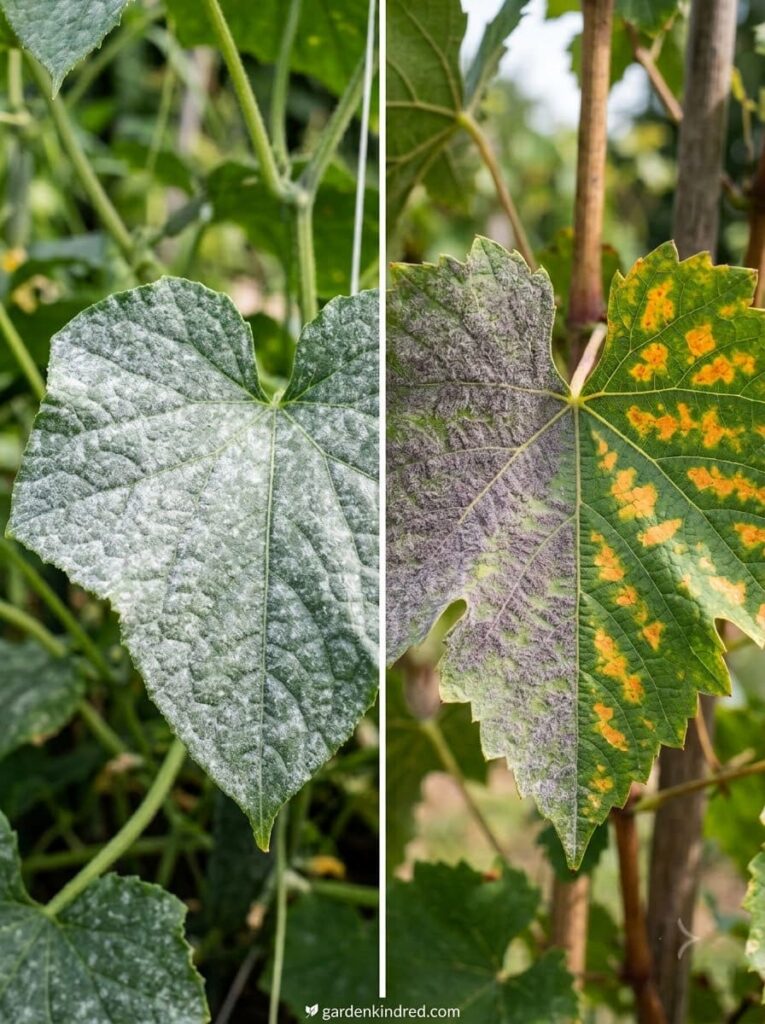
Powdery mildew sits on top of the leaf, usually the upper surface first, and looks like someone dusted the plant with flour or spilled powder. It wipes off on a finger fairly easily in early stages. It shows up on both leaf surfaces as the infection matures and does not require wet conditions.
Downy mildew, despite the similar name, is caused by an oomycete, a fungus-like organism more closely related to algae than to true fungi, according to Penn State Extension’s home garden guidance. It produces fuzzy gray, purplish, or bluish growth almost exclusively on the leaf underside, paired with angular yellow blotches on the top of the same leaf, and it thrives in cool, wet weather rather than the warm, dry days powdery mildew prefers. If you only see white dust on top and nothing on the underside, it is not downy mildew.
Dust, mineral spray residue, or pesticide film sits evenly across the whole plant including stems and nearby surfaces like a nearby fence post, doesn’t concentrate on new growth first, and doesn’t spread outward day over day the way an active fungal colony does.
Aphid or scale honeydew with sooty mold looks black and sticky rather than white and dry, and you’ll usually find the actual insects on the underside of nearby leaves if you look closely.
If the white coating is dry, powdery, concentrated on new growth and upper leaf surfaces, and spreading to a new leaf every couple of days, treat it as powdery mildew and move to Step 1.
Step 1: Confirm the Diagnosis Before You Treat Anything
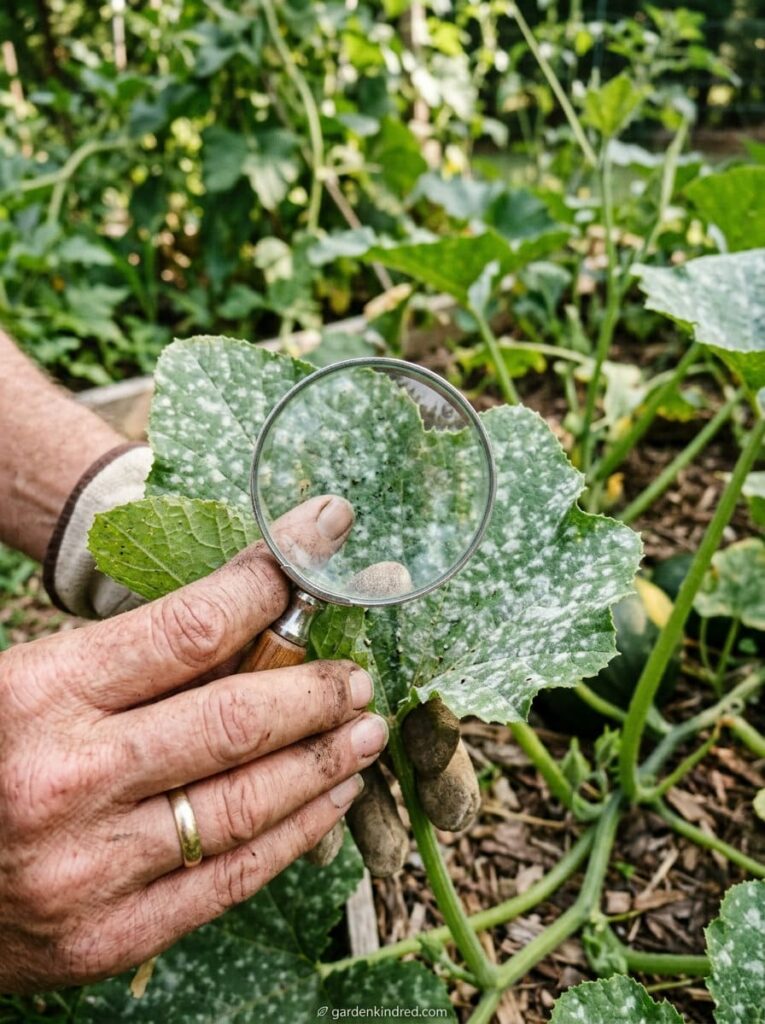
Before buying anything, walk the whole yard, not just the plant you noticed first. Because powdery mildew spreads by wind-borne spores that don’t care about plant family, a single outbreak often shows up simultaneously on a summer squash bed 40 feet from a mildewed garden phlox, with no direct contact between them.
Note every affected plant and roughly how far the infection has progressed on each one (just starting on new growth, moderate coverage, or already causing leaf drop), because that determines which of the next steps you start with.
Check the weather history for the past two weeks too. If nights have been running cool and humid and days warm and dry, and you’ve had six or more of those cycles, that confirms the fungus has had ideal launch conditions and you should expect the infection to keep advancing even if you do nothing else different, according to the pattern Colorado State Extension documents for powdery mildew development.
Step 2: Remove and Isolate Infected Material the Right Way
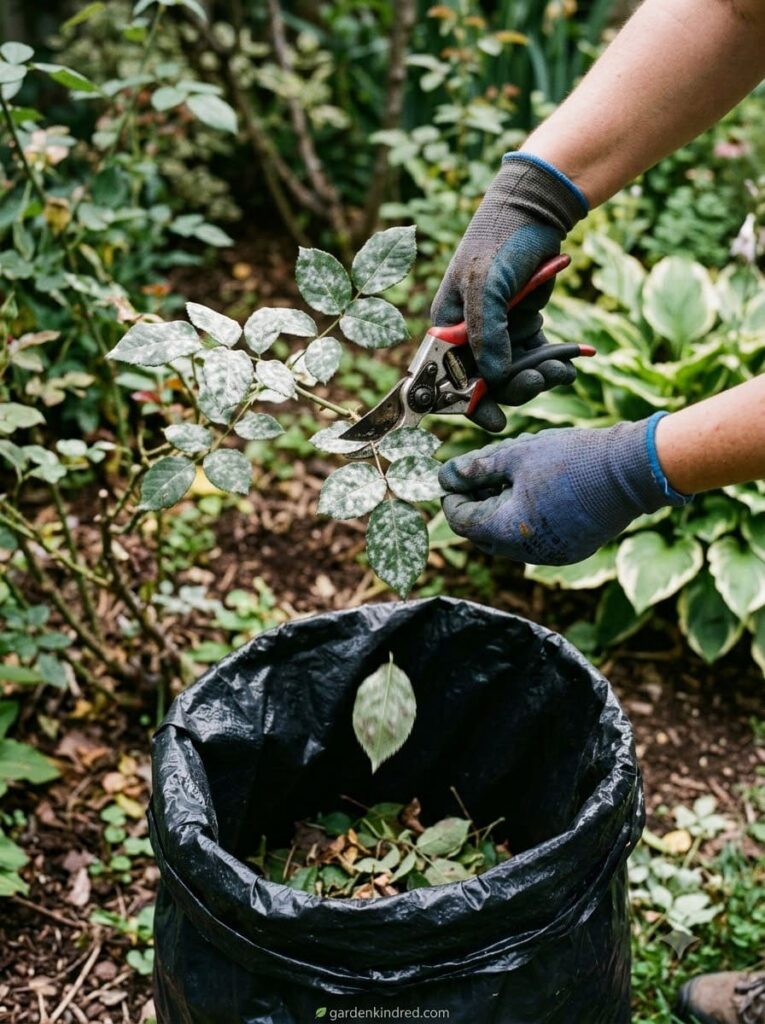
This step gets skipped or done wrong more than any other in this list. Prune off heavily infected leaves and stems, cutting a few inches into clean tissue when possible, and put the material straight into the trash or a sealed yard-waste bag, never the compost pile.
Home compost piles rarely sustain the 131°F+ sustained internal temperature for the multi-day period needed to kill fungal spores, so infected debris tossed on a home compost heap is a common source of the following year’s first infection, a point backed by UC Statewide IPM Program’s guidance on sanitation for powdery mildew on vegetables.
Sanitize pruning tools between cuts and definitely between plants, with a 10% bleach solution or isopropyl alcohol wipe. Spores can hitch a ride on blade residue and get carried directly to the next healthy plant you cut, undoing the point of pruning in the first place.
Don’t remove more than about a third of a plant’s live foliage in one session even if it’s heavily infected. Stripping a plant bare to “get rid of the mildew” often stresses it enough that it can’t recover even after the disease is controlled, particularly on annuals like squash and cucumber that are already carrying a heavy fruit load.
Step 3: Treat What’s Already Infected
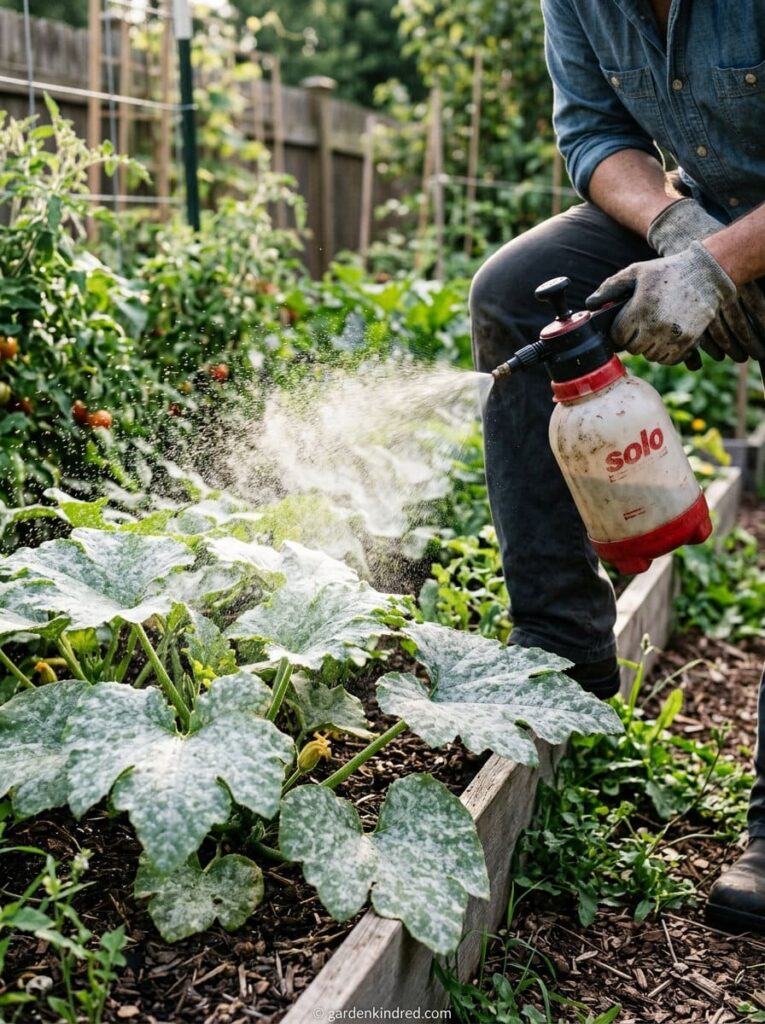
This is the step most guides blur together with Step 4, and the distinction matters because the two jobs use different chemistry. Treating leaves that already show mildew calls for a contact/eradicant product, something that kills existing fungal growth on contact rather than just blocking new spores from germinating.
Potassium bicarbonate products work by pulling water out of the fungal cells through osmotic pressure while disrupting the fungus’s internal ion balance, causing the cell wall to collapse, a mechanism confirmed in field trials published via the National Institutes of Health’s PMC archive on sugar beet powdery mildew control. Because that’s a physical mode of action rather than a biochemical one the fungus can adapt around, resistance is much less of a long-term concern than with some synthetic systemic fungicides.
Horticultural oils, including neem oil, coat and smother existing fungal mycelium and also disrupt spore germination on contact, but they carry real application limits: never spray oil-based products when temperatures are above roughly 85 to 90°F or in direct strong sun, since the combination can cause leaf burn, per University of Illinois Extension horticulture guidance repeated across most state extension spray-timing sheets.
Sulfur products have controlled powdery mildew for centuries and work best as a preventive rather than an eradicant on tissue that’s already heavily coated, since sulfur interferes with fungal respiration but needs direct, even coverage to work and doesn’t reliably knock back an established colony the way potassium bicarbonate can.
Step 4: Protect What’s Not Infected Yet
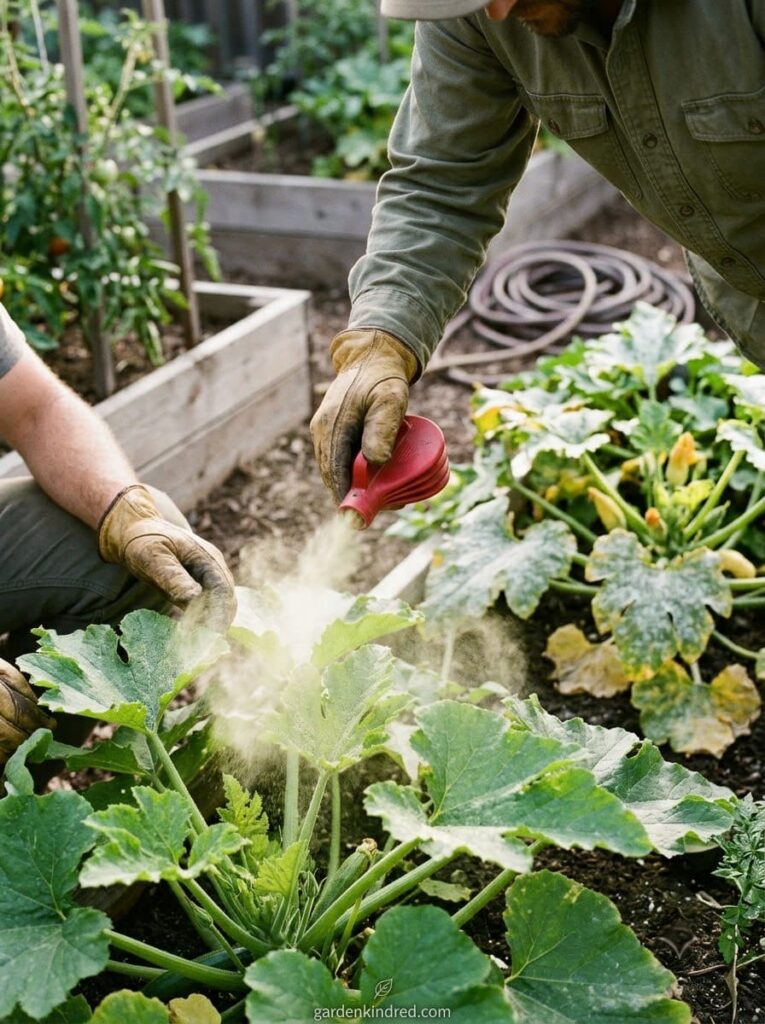
The plants near your outbreak that don’t show symptoms yet need a different job done to them: not eradication, but prevention, since there’s no active infection there to kill. This is where sulfur earns its reputation. Applied before symptoms appear and reapplied on a 7 to 14 day schedule (check the product label, since intervals vary by formulation and rainfall), sulfur forms a protective residue that stops spores from germinating on contact when they land, rather than trying to reverse an infection that’s already established.
Never apply sulfur within roughly two to three weeks of an oil-based spray (including horticultural or neem oil) on the same plant. The combination is a well-documented cause of severe leaf burn, called phytotoxicity, and it’s one of the most common home-gardener mistakes with these two otherwise-safe organic products, flagged specifically in Oregon State University Extension’s pesticide safety guidance for home orchards and gardens.
Timing your first preventive application matters more than the product choice. If a plant variety or location had powdery mildew last year, start a preventive sulfur or potassium bicarbonate program in early summer, before the cool-night, warm-day pattern typically begins, rather than waiting for the first white spot to appear.
Step 5: Fix the Conditions That Let Spores Germinate

Sprays buy time. They don’t fix the actual reason an outbreak keeps coming back to the same bed year after year, which is almost always a microclimate problem.
Increase airflow. Space new plantings according to their mature spread, not their nursery-pot size, and thin overcrowded stands mid-season if needed. Dense, still air around foliage holds the humid microclimate the fungus needs overnight even on a dry night regionally, since the plant canopy traps its own moisture.
Prune for circulation, not just size. On perennials, shrubs, and trees prone to repeat infections (lilac, phlox, and bee balm are classic repeat offenders per Missouri Botanical Garden’s plant health guidance), remove some interior branching each dormant season specifically to open the canopy, not just to control overall shape.
Water at the base, in the morning. This directly contradicts the instinct to avoid getting leaves wet, but remember the mechanism from earlier: standing water on a leaf surface can actually inhibit spore germination in several powdery mildew species. The real problem with overhead watering is timing, not wetness. Morning watering lets foliage dry by afternoon. Evening watering leaves foliage damp overnight into the exact humid window when spores are forming, which is the actual risk.
Increase sun exposure where realistic. Shaded, humid microclimates (a bed tucked against a fence with poor cross-ventilation, or under a tree canopy) develop chronic mildew pressure that full-sun beds nearby often escape entirely, even growing the same plant species.
Step 6: Stop Reinfection Next Season

Powdery mildew fungi overwinter in two main ways depending on species: as dormant mycelium in infected buds and bark crevices on perennials like roses and lilacs, or as tough survival structures called chasmothecia (previously called cleistothecia) in fallen leaf litter and plant debris on annuals like squash and cucumber, per University of California Statewide IPM Program’s disease cycle documentation. Either way, this year’s debris is next year’s spore source if it’s left in place.
Do a full fall cleanup on any bed that had an outbreak: remove and discard (never compost) all fallen leaves and dead top growth from annuals, and prune out any visibly discolored or cracked bark sections on perennial hosts during dormant-season pruning.
Choose resistant varieties for repeat-problem spots going forward. Plant breeders have made real progress here, particularly in vegetables. Powdery mildew resistant cultivars exist for cucumber, cantaloupe, pumpkin, and summer squash, developed from wild species-derived resistance loci identified through university breeding programs, according to research published via the National Institutes of Health’s PMC archive on cucurbit breeding. For ornamentals like phlox and bee balm (Monarda), look specifically for cultivars marketed as mildew-resistant selections, since straight species and older cultivars of both are especially prone to it.
Which Plants Are Most Vulnerable to Powdery Mildew?
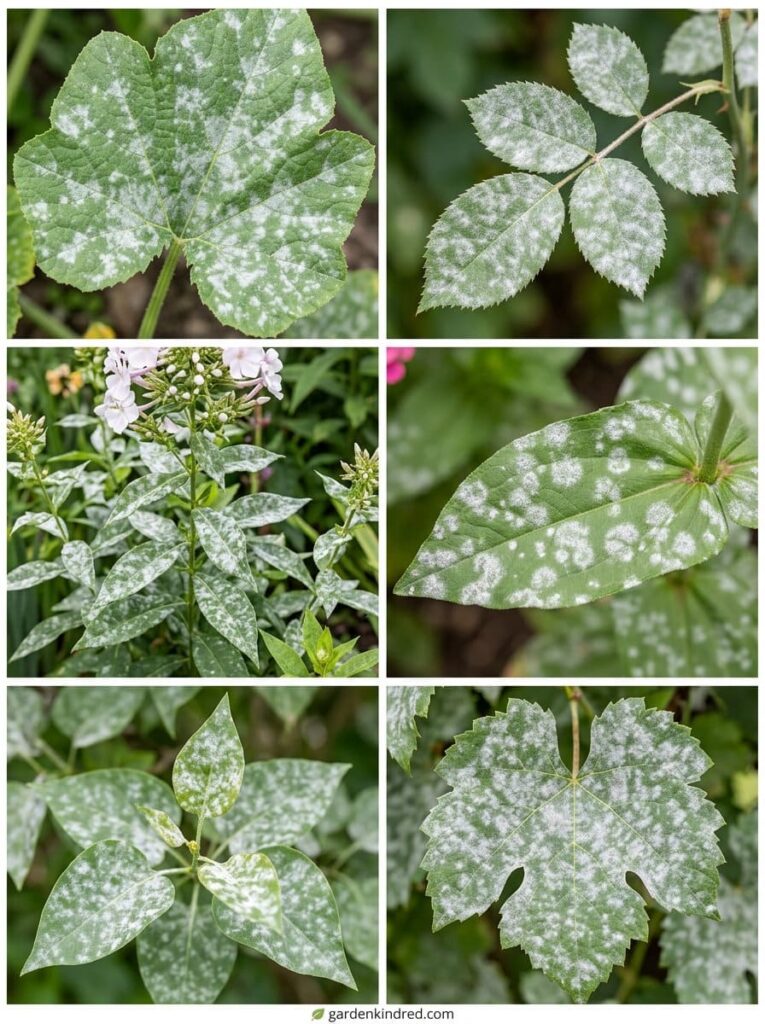
Because this fungus family isn’t picky about plant family, the vulnerable-plant list spans nearly every category of home garden. Clemson University’s Home & Garden Information Center lists cucurbits (squash, cucumber, melon, pumpkin), roses, phlox, zinnias, bee balm (Monarda), lilacs, crape myrtle, apples, and grapes among the most consistently affected landscape and garden plants in the home garden setting, though the specific fungal species involved differs by host, which is why a treatment applied to squash won’t jump over and infect your roses even in a bad outbreak year.
| Plant group | Common hosts | Typical first symptom | Peak-risk season |
|---|---|---|---|
| Cucurbits | Squash, cucumber, pumpkin, melon | White spots on top of older leaves first | Mid to late summer |
| Roses | Hybrid tea, climbing, shrub roses | New growth and buds coated first | Late summer, humid climates |
| Perennials | Phlox, bee balm, zinnia | Lower leaves first, moving upward | Late summer into fall |
| Woody ornamentals | Lilac, crape myrtle | Scattered leaf patches, rarely fatal | Summer |
| Fruit | Apple, grape | New shoot tips and young fruit | Spring through midsummer |
Treatment Options at a Glance
| Product type | Mechanism | Best use case | Reapplication interval |
|---|---|---|---|
| Potassium bicarbonate | Osmotic desiccation, disrupts fungal ion balance, contact/eradicant | Already-infected leaves, organic gardens | Every 7 days or after rain |
| Neem oil / horticultural oil | Smothers existing mycelium, blocks spore germination on contact | Infected tissue, not above 85-90°F or in strong sun | Every 7-14 days |
| Sulfur | Interferes with fungal respiration, mainly protectant | Preventing new infection on healthy tissue | Every 7-14 days, never within 2-3 weeks of an oil spray |
| Resistant varieties | Genetic resistance loci, no spray needed | Long-term prevention in repeat-problem beds | N/A |
Frequently Asked Questions About Powdery Mildew

Can powdery mildew kill my plant?
Rarely outright, but it can weaken a plant enough that something else finishes the job. Powdery mildew reduces photosynthesis in affected leaves and can cause premature leaf drop, which stresses the plant and reduces yield on food crops or bloom count on ornamentals. Young plants and plants already stressed by drought or heat are more likely to suffer serious dieback from a heavy infection, per Colorado State University Extension.
Does baking soda actually work on powdery mildew?
Plain baking soda (sodium bicarbonate) has weaker, less consistent efficacy than potassium bicarbonate in university trials, and can build up sodium in the soil with repeated use. Potassium bicarbonate products are the tested, more reliable version of the same basic chemistry, which is why Step 3 above recommends potassium bicarbonate specifically rather than a homemade baking soda mix.
Will powdery mildew spread from my squash to my roses?
Not directly. Most powdery mildew fungi are host-specific at the species level, meaning the fungal species infecting your squash is a different species than the one that infects roses, even though both diseases look nearly identical and both love the same weather pattern. That’s exactly why a bad August can hit unrelated plants across your whole yard at once without one infecting the other.
How long do powdery mildew spores survive in the garden?
Overwintering structures called chasmothecia can survive in fallen leaf litter and bark crevices through an entire winter and release new spores the following spring or summer when conditions turn favorable again, per UC Statewide IPM Program’s disease cycle research. That’s the entire reason Step 6’s fall cleanup step exists, skipping it effectively reseeds next year’s outbreak.

Never miss an update — choose Garden Kindred as your preferred source on Google.
How it works: Tap the button below to open Google's settings page, then check the box next to Garden Kindred.
Tap the checkbox to turn it blue — that's how you know it's set.