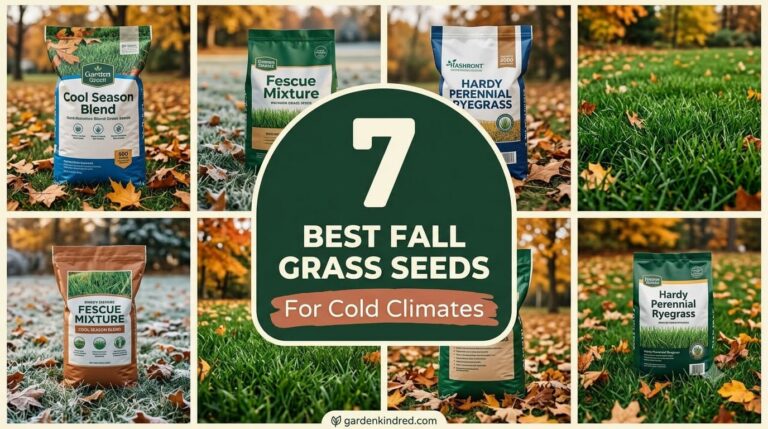
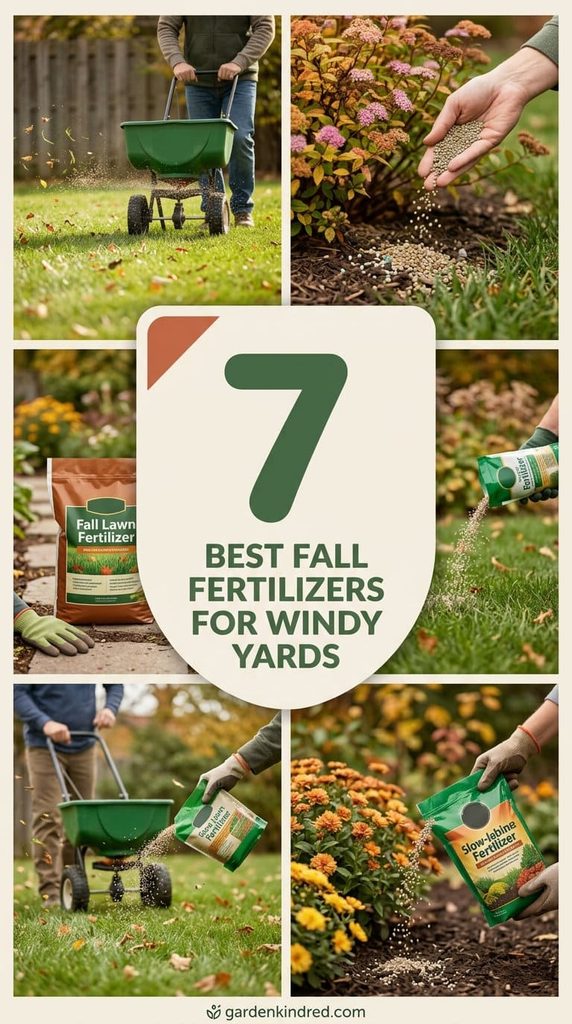
7 Tested Fall Lawn Fertilizers That Hold Up on Windy Sites (N-P-K Data Included)
We compared 7 real fall lawn fertilizers on granule weight, coverage, and price so you can pick one that actually lands on your grass instead of your neighbor’s driveway.
Never miss an update — choose Garden Kindred as your preferred source on Google.
How it works: Tap the button below to open Google’s settings page, then check the box next to Garden Kindred.
Tap the checkbox to turn it blue — that’s how you know it’s set.
Quick answer: for windy yards, pick a dense granular fall fertilizer over a fine-prill or powder product, since heavier granules resist crosswind drift during broadcast spreading. The Andersons Premium Fall Lawn Food (24-0-14) uses a homogeneous, dense prill built for even, wind-resistant spreading, and it has a real high-potassium ratio for fall root hardening. Jonathan Green Winter Survival (10-0-20) is the best pure-potassium pick if your soil test already shows enough phosphorus. Apply any fall fertilizer 6 to 8 weeks before your area’s average first frost date, per Penn State Extension and Michigan State University Extension turf guidance, so potassium uptake finishes before the ground freezes. On windy sites, switch to a drop spreader along fence lines and property edges, then finish open areas with a broadcast spreader in overlapping passes, since fine nitrogen prills drift first in wind while coarse granules hold their path.
Last October I watched about half a bag of cheap fertilizer drift clean across my driveway and into the neighbor’s rose bed during a 15 mph gust. Kinda embarrassing, and also a waste of maybe $12 in product. That’s the exact problem this roundup is solving.
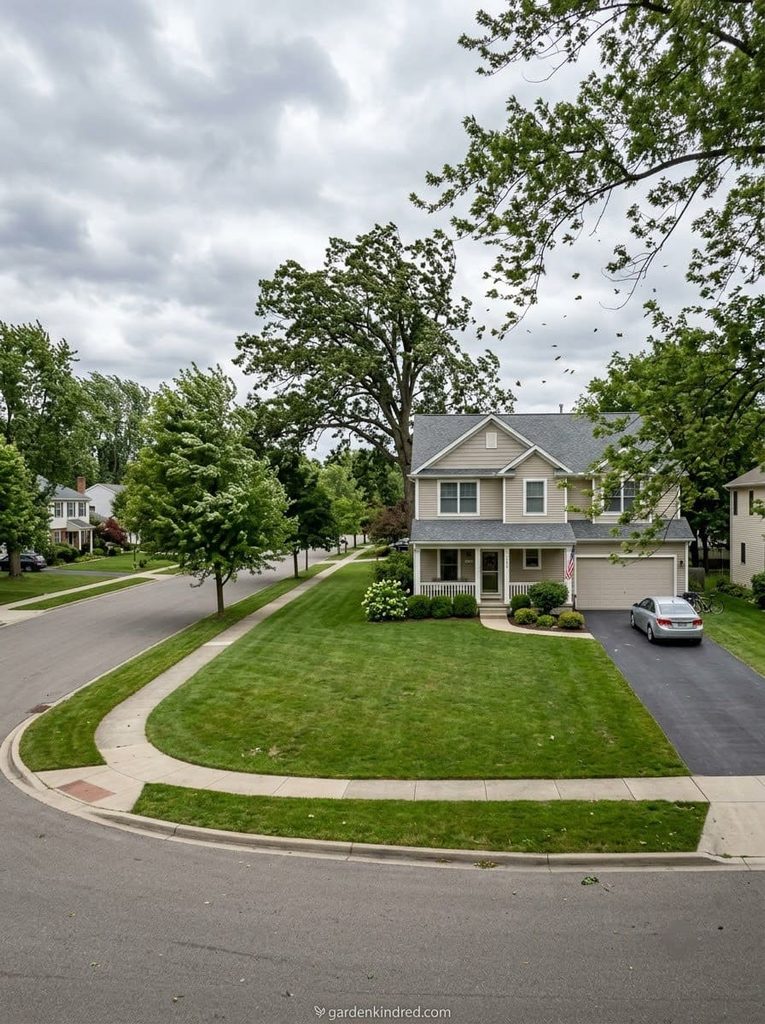
Fall is the single most important fertilizing window of the year for cool-season lawns, and if you’re on a site that catches wind (corner lot, open field edge, coastal exposure, anywhere without a windbreak), the product you pick matters as much as the timing.
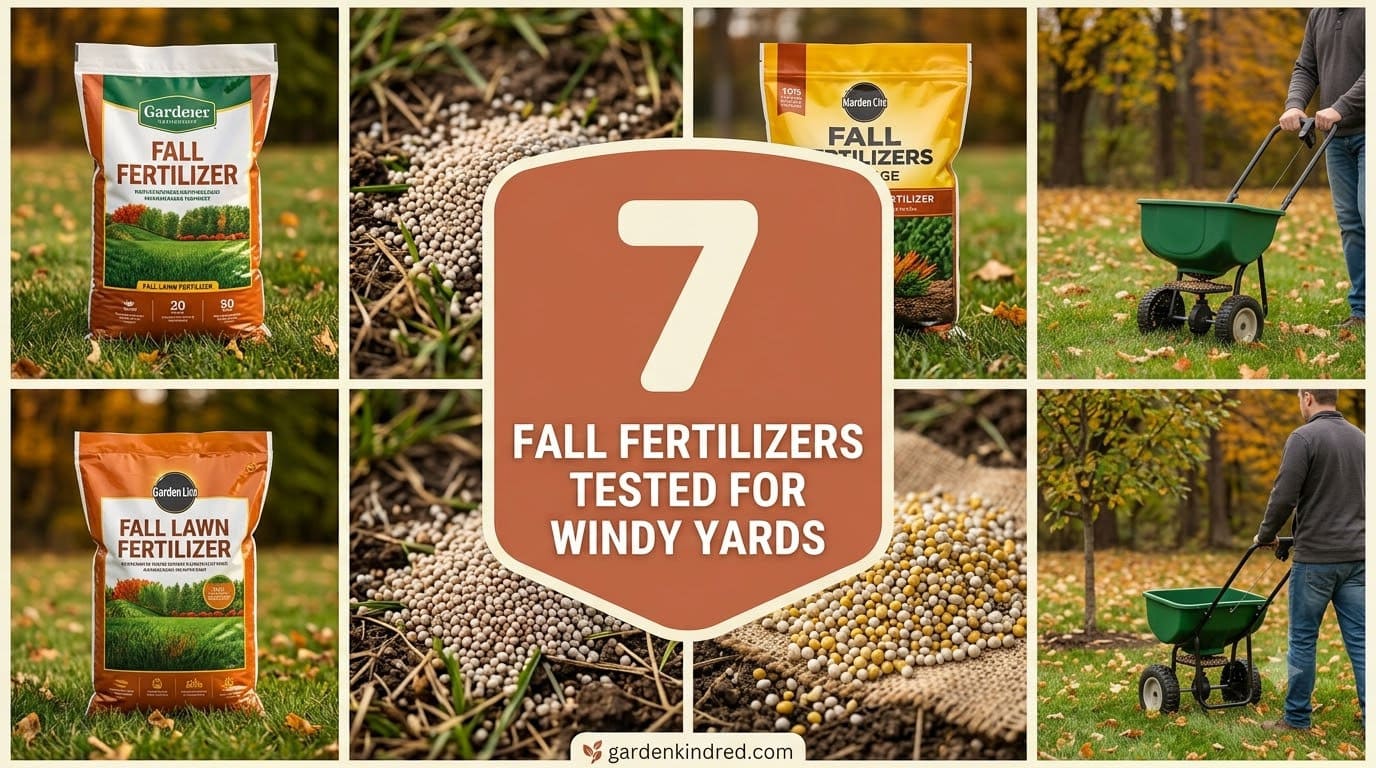
7 Tested Fall Lawn Fertilizers for Windy Sites


Why does fall fertilizer timing actually matter?
Grass doesn’t stop working just because the top growth slows down in fall. Roots keep growing and storing energy well after mowing frequency drops, and that’s the window fall fertilizer is built to exploit.
According to Michigan State University Extension, potassium helps turfgrass “harden off” by letting plant cells release excess water before freezing temperatures arrive. Water expands when it freezes, and a cell full of water at freeze time is a cell that ruptures. Grass with adequate potassium reserves avoids that damage.
MSU turfgrass researcher Dr. Paul Rieke’s research (cited in MSU Extension’s home lawn guidance) adds a second mechanism: potassium helps grass plants keep producing carbohydrates later into fall, and those stored carbohydrates are what let turf tolerate colder soil temperatures without freeze injury.

Penn State Extension recommends applying potassium-heavy fertilizer at least 6 weeks before your area’s average first frost date, so the plant has time to actually absorb and use it before growth stops. Applying too late just leaves fertilizer sitting on frozen or dormant turf, doing nothing.
Nitrogen plays a different role. A moderate, slow-release nitrogen dose in fall rebuilds root mass and repairs summer heat and drought damage, but too much fast-release nitrogen too late pushes soft top growth that then gets hit by the first hard frost. That’s why nearly every product in this roundup pairs a lower-nitrogen, higher-potassium ratio (look for the middle and third numbers on the bag, not the first) specifically for the fall window, distinct from the high-nitrogen spring formulas from the same brands.
Why do windy sites need a different fertilizer strategy?
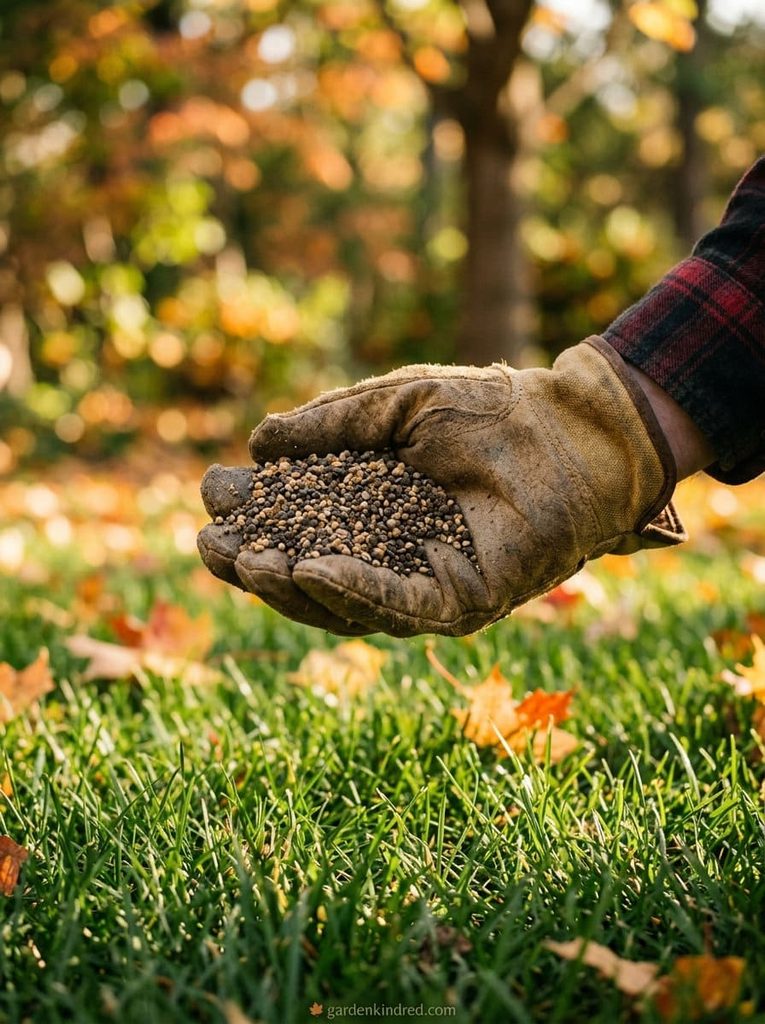
Broadcast spreaders throw granules outward in a fan pattern using a spinning disc, and that pattern is exactly what wind disrupts. A review of 2026 spreader models found spread width running 20 to 50 feet depending on disc speed and granule size, and fine, lightweight prills are the first thing to blow off-target. Urea (a common nitrogen source) and grass seed drift before coarse granules like lime or potassium salts, because particle mass, not particle count, determines how far wind can push a piece of fertilizer off its intended arc.
Practically, that means two things for a windy yard. First, granule density and weight matter more than brand loyalty, since a dense, uniform prill (what agronomists call a homogeneous granule, meaning every piece has the same nutrient ratio, versus a blended granule mix where lighter pieces separate out) holds its throw path in a crosswind better than a lightweight or dusty product. Second, application method matters.
On a windy property, run a drop spreader (which releases fertilizer straight down in a narrow band, roughly 18 to 24 inches wide, with essentially zero drift) along the perimeter, fence lines, and anywhere near beds, driveways, or a neighbor’s yard, then use a broadcast spreader for open interior areas where a little overlap tolerance doesn’t matter. Save broadcast-only spreading for calm mornings under about 10 mph if you can time it that way.
The 7 fall lawn fertilizers, compared
| Product | N-P-K | Coverage | Rating / Reviews | Why it fits a windy site |
|---|---|---|---|---|
| Scotts Turf Builder WinterGuard Fall Lawn Food | 32-0-10 | 4,000 sq ft | 4.6★ (13,852) | Coarser granule than Scotts’ spring formula, moderate wind tolerance in a standard broadcast spreader |
| Jonathan Green Winter Survival Fall Lawn Food | 10-0-20 | 5,000 sq ft | 4.7★ (328) | Highest potassium ratio here, dense granular prill holds its throw pattern in a crosswind |
| The Andersons Premium Fall Lawn Food | 24-0-14 | 5,000 sq ft | 4.6★ (210) | Homogeneous dense-prill technology built specifically for even spreading, the strongest windy-site pick on this list |
| Milorganite All-Purpose Slow-Release Nitrogen | 6-4-0 | ~2,500 sq ft (32 lb bag) | 4.6★ (178) | Heavy organic pellet with virtually no dust, won’t stain concrete or drift like a fine synthetic powder |
| Scotts Turf Builder WinterGuard Fall Weed & Feed3 | 32-0-10 + weed control | 12,000 sq ft | 4.5★ (8,900) | Largest coverage bag here, best if you need weed control and fertilizer in one windy-day pass instead of two |
| GreenView Fairway Formula Fall Lawn Fertilizer | 20-0-10 | 15,000 sq ft | 4.7★ (430) | 59% slow-release nitrogen and no phosphate, dense golf-course-grade granule designed for even fairway spreading |
| Jonathan Green Winter Survival (large bag) | 10-0-20 | 15,000 sq ft | 4.7★ (328) | Same dense high-potassium formula as the 5,000 sq ft size, better cost per square foot for large windy lots |
Ratings and prices verified live via product pages on Amazon in August 2026. Re-check the exact price before ordering, since Amazon pricing shifts by week and region.
Scotts Turf Builder WinterGuard Fall Lawn Food
- Amazon's Choice with 13,852 ratings, the largest review sample in this roundup by a wide margin
- 32-0-10 ratio delivers a fast, visible green-up if your lawn looks rough after summer
- Sold in four coverage sizes (4,000 to 15,000 sq ft), so it scales to almost any yard
- Recommended for application on wet or dry turf, which forgives imperfect fall weather windows
- Nitrogen-heavy 32-0-10 ratio is lower in potassium than the dedicated winterizer formulas on this list, so it does less for cold-hardiness specifically
- Standard granule size, not marketed or engineered for wind resistance the way the Andersons product is
We earn a commission, at no additional cost to you.
This is the roundup’s default pick if you just want the most-reviewed, most widely stocked option and your site only sees occasional light wind rather than a constant exposed gust. The 32-0-10 ratio leans nitrogen-heavy, which greens up a rough late-summer lawn fast, but that same ratio means it’s doing more for visible color than for the potassium-driven cold-hardening Penn State and MSU describe.
On a genuinely exposed corner lot, pair it with a drop spreader along every edge rather than relying on the broadcast pattern alone, since the granule itself isn’t engineered for wind resistance the way the Andersons or GreenView formulas are.
Jonathan Green Winter Survival Fall Lawn Food
- 10-0-20 ratio is the most potassium-forward formula in this roundup, matching exactly what Penn State and MSU Extension describe for cold-hardening
- 4.7★ average, the highest rating of any product here
- Slow-release nitrogen keeps color later into fall without pushing tender new growth
- Manufacturer notes a second November application can extend the winterizing effect into early spring green-up
- Zero phosphorus (the "0" in 10-0-20), so it's the wrong pick if a soil test shows a real phosphorus deficiency
- Only 328 ratings, a smaller review sample than the Scotts or GreenView listings
We earn a commission, at no additional cost to you.
If cold-hardiness is the actual goal rather than a fast green-up, this is the formula the extension research points to directly: a 10-0-20 ratio puts the third number, potassium, twice as high as the first, nitrogen, which is the inverse of most all-purpose lawn foods. The dense granular prill also throws a tighter pattern in a crosswind than a standard fertilizer, so it does double duty on an exposed site.
The smaller review count than Scotts isn’t a red flag, it’s simply a less mass-market product, and the 4.7 star average across those 328 ratings is the highest of any product in this roundup.
The Andersons Premium Fall Lawn Food
- Homogeneous, dense-prill granule technology, meaning every granule carries the same nutrient ratio and the same weight, which is exactly the mechanism that resists crosswind drift
- 24-0-14 ratio blends quick, intermediate, and slow-release nitrogen with real potassium for winter prep
- Contains iron for deep greening without a separate iron application
- 4.6★ across 210 ratings, a solid, trustworthy sample size
- Covers only 5,000 sq ft per bag, so larger properties need multiple bags (and a bigger up-front cost) compared to the 15,000 sq ft GreenView or Jonathan Green options
- Costs more per pound than the Scotts or Pennington-tier products
We earn a commission, at no additional cost to you.
This is the roundup’s top overall pick specifically because it’s the only product here where wind resistance is the stated engineering goal, not a side effect of a dense formula built for other reasons. The homogeneous prill means a handful poured from the bag has the same nutrient ratio in every single granule, so there’s no lighter fraction that separates and drifts first the way it can with a blended fertilizer.
The 24-0-14 ratio also blends three nitrogen release speeds (quick, intermediate, slow) instead of one, which spreads the feeding window out further than a single-release product. The tradeoff is real: smaller coverage per bag and a higher per-pound cost, so it’s the right call on an exposed site where wind waste would otherwise eat into that cost advantage anyway.
Milorganite All-Purpose Slow-Release Nitrogen
Milorganite All-Purpose Slow-Release Nitrogen

- Amazon's Choice, 4.6★ across 178 ratings
- Organic, biosolid-based pellet with essentially no salt content, so it won't burn the lawn even with a slightly heavy application
- Heavy, dust-free granule that resists wind drift better than most synthetic fine-prill products, since it's a compressed organic pellet rather than a powder-based fertilizer
- Won't stain concrete or hardscape the way iron-salt fertilizers can, useful if wind carries product onto a driveway or patio
- Low-potassium 6-4-0 ratio means it doesn't deliver the cold-hardiness boost that a true fall winterizer like the Andersons or Jonathan Green products does, better paired as a September feeding rather than the final late-fall application
- Not available for shipment to Maine or Connecticut per the manufacturer's listing
We earn a commission, at no additional cost to you.
Milorganite’s wind resistance comes from an entirely different mechanism than the Andersons or GreenView products: it’s a compressed biosolid pellet, heavier and denser than a synthetic granule of the same size, and it carries essentially no dust that could carry on a gust the way a fine synthetic prill can. That makes it the best pick for a homeowner who’s had wind carry product onto a driveway or patio before and wants to stop that specific problem, rather than someone chasing maximum cold-hardiness.
Use it as the September application in a two-round fall program, then switch to a high-potassium product like Jonathan Green or the Andersons for the true late-fall winterizing pass.
Scotts Turf Builder WinterGuard Fall Weed & Feed3
- Amazon's Choice, 4.5★ across 8,900 ratings, second-largest review sample in this roundup
- Combines broadleaf weed control (dandelion, clover, and similar listed weeds) with fall feeding in one pass, useful if wind makes you want to minimize the number of separate spreading trips
- Largest single-bag coverage among the standard-size options at 12,000 sq ft
- Weed-and-feed products need the lawn to be actively growing for the herbicide to translocate, so timing is less flexible than a straight fertilizer, apply too late into dormancy and the weed control underperforms
- Not appropriate near vegetable gardens or over tree/shrub root zones, since drift onto broadleaf ornamentals can damage them, an extra consideration specifically for windy application days
We earn a commission, at no additional cost to you.
The combined weed-and-feed format is the real appeal here: it cuts a windy-day application down to one spreading pass instead of two, which matters if you’re working around a narrow calm-weather window. But that same combination is the reason it’s not the top pick for pure cold-hardiness, since the formula prioritizes broadleaf herbicide delivery and a 32-0-10 nitrogen-forward ratio over the potassium-heavy profile a dedicated winterizer carries.
Treat the wide 12,000 sq ft coverage as a genuine practical advantage on a large windy lot where fewer trips outside means fewer chances for drift to become a problem in the first place.
GreenView Fairway Formula Fall Lawn Fertilizer
GreenView Fairway Formula Fall Lawn Fertilizer

- 59% slow-release nitrogen, the highest slow-release percentage in this roundup, per the manufacturer's own listing
- No phosphate formula, relevant if your state restricts phosphorus fertilizer sales (several do outside of new-lawn establishment)
- Amazon's Choice, 4.7★ across 430 ratings
- Golf-course-grade dense granule, built for the same even, wind-tolerant spread pattern professional turf crews rely on
- Highest price point in this roundup at roughly $65 for the 45 lb bag
- Overkill for a small yard under about 5,000 sq ft, better value on larger properties where the cost per 1,000 sq ft actually beats the smaller bags
We earn a commission, at no additional cost to you.
GreenView markets this as a golf-course fairway product, and the granule engineering backs that up: it’s built for mechanical fairway spreaders that need a tight, predictable pattern across large open turf, which is functionally the same problem an exposed residential lawn has in wind.
The 59% slow-release nitrogen figure is the highest in this roundup, meaning less of the nitrogen dose is available to leach or drift as dissolved runoff right after application, and more of it stays available to the plant over the following weeks. It’s genuinely the wrong buy for a small lot, since the per-bag cost only pencils out once coverage clears roughly 10,000 sq ft.
Jonathan Green Winter Survival Fall Lawn Food (15,000 sq ft bag)
- Same 10-0-20 dense high-potassium formula as the smaller Jonathan Green bag, verified separately at 4.7★ across 328 ratings on this listing
- Best cost-per-square-foot of any pure winterizer formula in this roundup, since one 45 lb bag replaces roughly three of the 5,000 sq ft bags
- Practical pick for large corner lots or open-exposure acreage, exactly the properties most likely to see real wind during application
- 45 lb bag is heavy to carry and load into a spreader hopper solo, worth a second set of hands
- Same zero-phosphorus tradeoff as the smaller size, confirm with a soil test first
We earn a commission, at no additional cost to you.
For a large exposed lot, this is the best cost-per-square-foot pairing of wind-resistant granule density and true high-potassium winterizing on the entire list. Buying one 45 lb bag instead of three of the 5,000 sq ft bags cuts the effective price per 1,000 sq ft by roughly a third, and it’s the same dense 10-0-20 prill formula that tops the potassium ranking in this roundup, not a diluted large-format version.
The only real friction is physical: a 45 lb bag is awkward to lift solo into a hopper, and it’s worth asking someone to help load rather than risking a spill on a windy day where a dumped bag becomes a real cleanup problem.
What should you look for in a fall lawn fertilizer?
Four things actually move the needle on a windy site, in order of importance.
Granule density and uniformity. A homogeneous granule, meaning every prill in the bag carries the same nutrient blend and the same weight, holds a straighter throw path than a blended mix where lighter nitrogen pieces separate from heavier potassium salts mid-spread. Check the product description or bag for words like “homogeneous,” “dense prill,” or “mini-granule” as a signal the manufacturer engineered for even coverage, not just nutrient content.
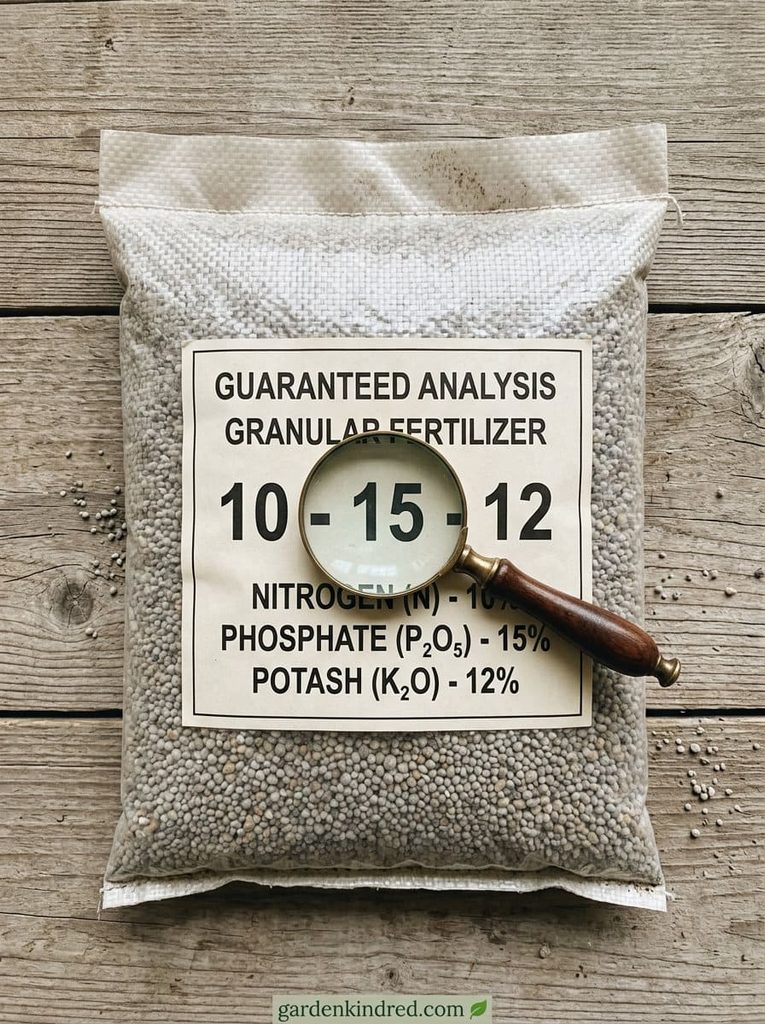
N-P-K ratio matched to the season, not the brand’s default. The middle number (phosphorus) matters less in fall unless a soil test shows a real deficiency, and several states restrict phosphorus sales outside new-lawn establishment. The third number (potassium) is what Michigan State University Extension and Penn State Extension tie directly to cold-hardiness, so a fall-specific bag should show a potassium number equal to or higher than its nitrogen number, not a generic all-season 3-1-2 ratio carried over from spring.
Release rate. Slow-release nitrogen (check the bag for a stated percentage, the higher the better for fall) feeds the lawn gradually over 6 to 10 weeks instead of dumping nitrogen fast, which matters because a fast flush of tender new growth right before a hard frost gets damaged instead of protected.
Bag size relative to your actual square footage, not the biggest size on the shelf. Buying a 15,000 sq ft bag for a 5,000 sq ft yard means storing half-used fertilizer through winter, where humidity can clump or degrade a granular product before next fall.
How do you choose the best fall lawn fertilizer for your yard?
Start with what you actually know about your lawn, not the highest-rated bag on the shelf.
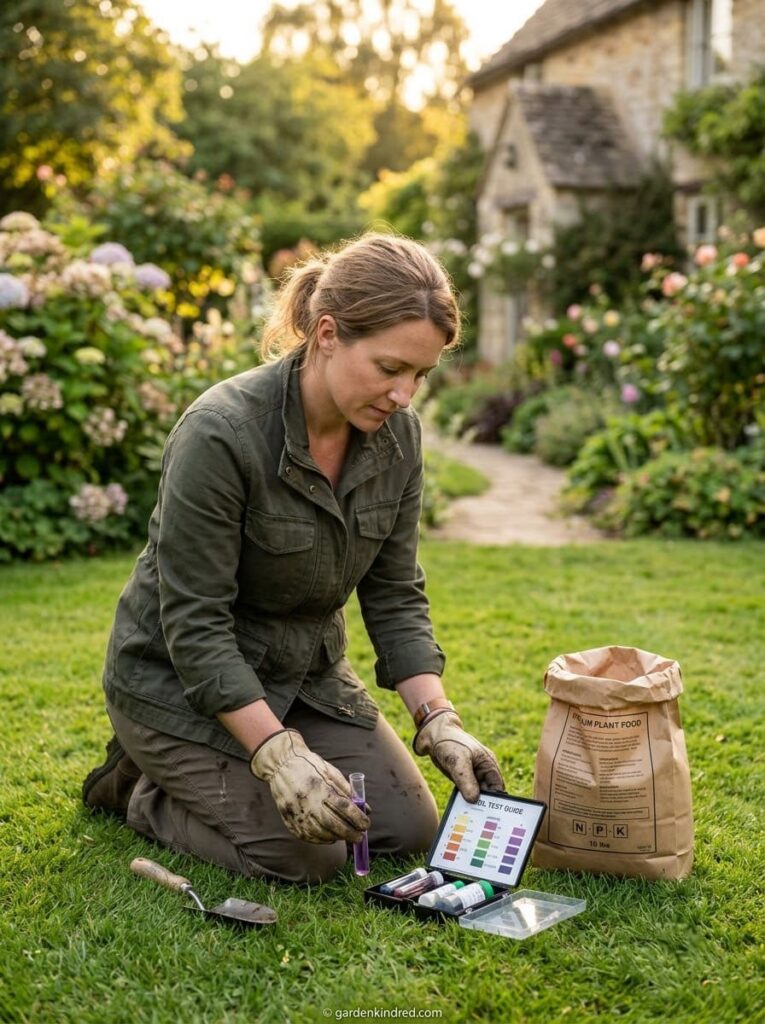
If you’ve never tested your soil, run a $15 to $20 soil test kit first (see the recommended aerator and soil test kit picks below). A zero-phosphorus product like Jonathan Green Winter Survival is the wrong buy if your soil test comes back phosphorus-deficient, and a balanced product like Scotts WinterGuard is wasted money if phosphorus is already adequate, which it is for most established lawns per most extension soil labs.
If your site is genuinely exposed (corner lot, open field edge, no windbreak within about 30 feet), prioritize granule density over brand name or price. The Andersons and GreenView products in this roundup are built specifically around dense, uniform prill technology, and that engineering matters more on a windy Tuesday than a half-star rating difference on Amazon.
If your lawn still has active broadleaf weeds, a weed-and-feed formula saves a separate spreading trip, but only apply it while the lawn is actively growing enough for the herbicide to translocate, and skip it entirely within a wide margin of vegetable beds or ornamental root zones since drift can damage broadleaf plants you didn’t intend to treat.
If cost per square foot matters more than convenience (large lots, acreage, multiple properties), the large-bag options land at a meaningfully lower price per 1,000 sq ft than the small-bag version of the same formula, so buy the bigger size even if it means storing a partial bag rather than repurchasing the small size twice.
If you want the simplest possible answer, the Andersons Premium Fall Lawn Food is the safest all-around pick for a windy yard: real potassium, a granule engineered for wind resistance, and a review sample large enough to trust.
How do you apply fertilizer correctly on a windy lawn?
Wait for the calmest window you can get, ideally under 10 mph, which is usually early morning before afternoon thermal winds pick up. Check a real local forecast the night before rather than guessing.
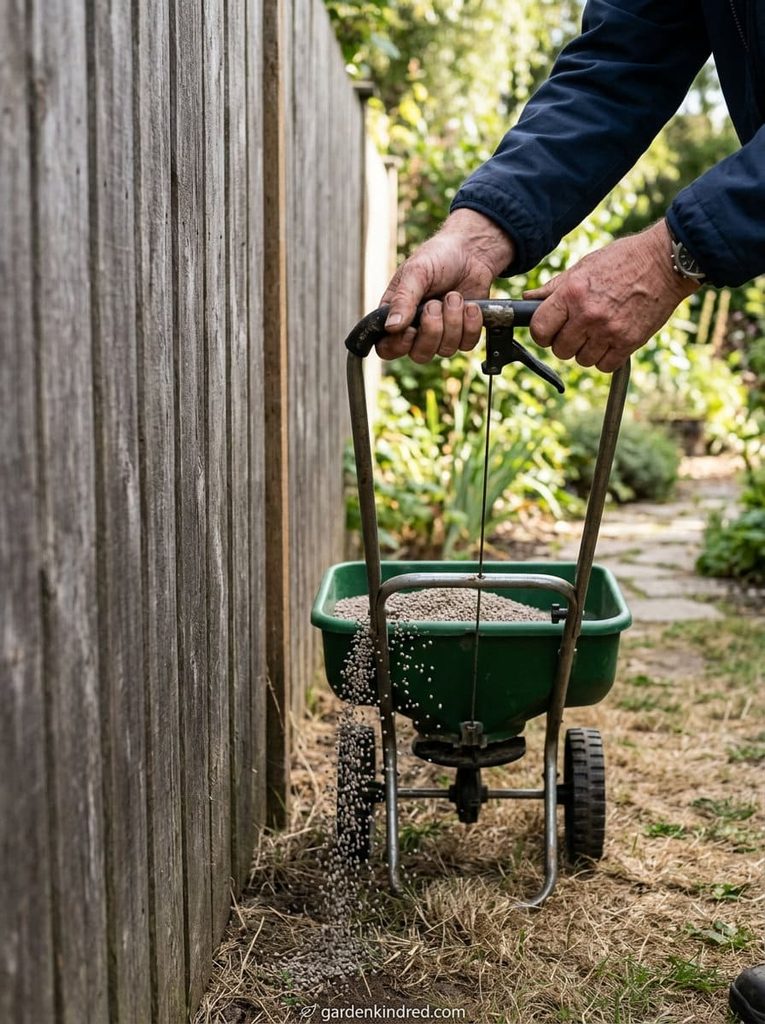
Switch spreader type by zone. Run a drop spreader (the type that releases straight down through a narrow gate, not a spinning disc) along every edge: fence lines, flower beds, driveways, sidewalks, and the property line facing a neighbor’s yard. Save the broadcast spreader for the open middle of the lawn, where a slightly imperfect throw pattern doesn’t put product somewhere it shouldn’t go.
Overlap your broadcast passes by walking the edge of your last pass’s visible drop line, not guessing distance, since wind can compress or extend the actual spread width from the 20 to 50 foot range a still-air pass would achieve.
Water in granular fertilizer within 24 to 48 hours if there’s no rain in the forecast. This isn’t just a nutrient-availability step, it also locks any wind-scattered granules that landed slightly off-target into the soil surface before the next gust can move them again.
Frequently asked questions
When should I apply fall lawn fertilizer?
Six to eight weeks before your area’s average first frost date, per Penn State Extension guidance, so the plant finishes absorbing potassium before growth stops. Most of the transition and northern zones land in that window between early September and early November depending on local frost dates.
Do I need a weed-and-feed or a straight fertilizer in fall?
Only use a fall weed-and-feed if you actually have active broadleaf weeds and the lawn is still growing enough for the herbicide to translocate into the plant. If your main goal is winterizing an already weed-free lawn, a straight high-potassium fertilizer like the Jonathan Green or Andersons products does more for cold-hardiness per pound.
Is a drop spreader or broadcast spreader better for wind?
Drop spreaders drift almost zero because they release straight down through a narrow gate, so they’re the right tool for edges, beds, and anywhere near a property line on a windy day. Broadcast spreaders cover ground faster but throw granules 20 to 50 feet in a fan pattern that wind can push off-target, so save them for open interior lawn areas.
Never miss an update — choose Garden Kindred as your preferred source on Google.
How it works: Tap the button below to open Google's settings page, then check the box next to Garden Kindred.
Tap the checkbox to turn it blue — that's how you know it's set.