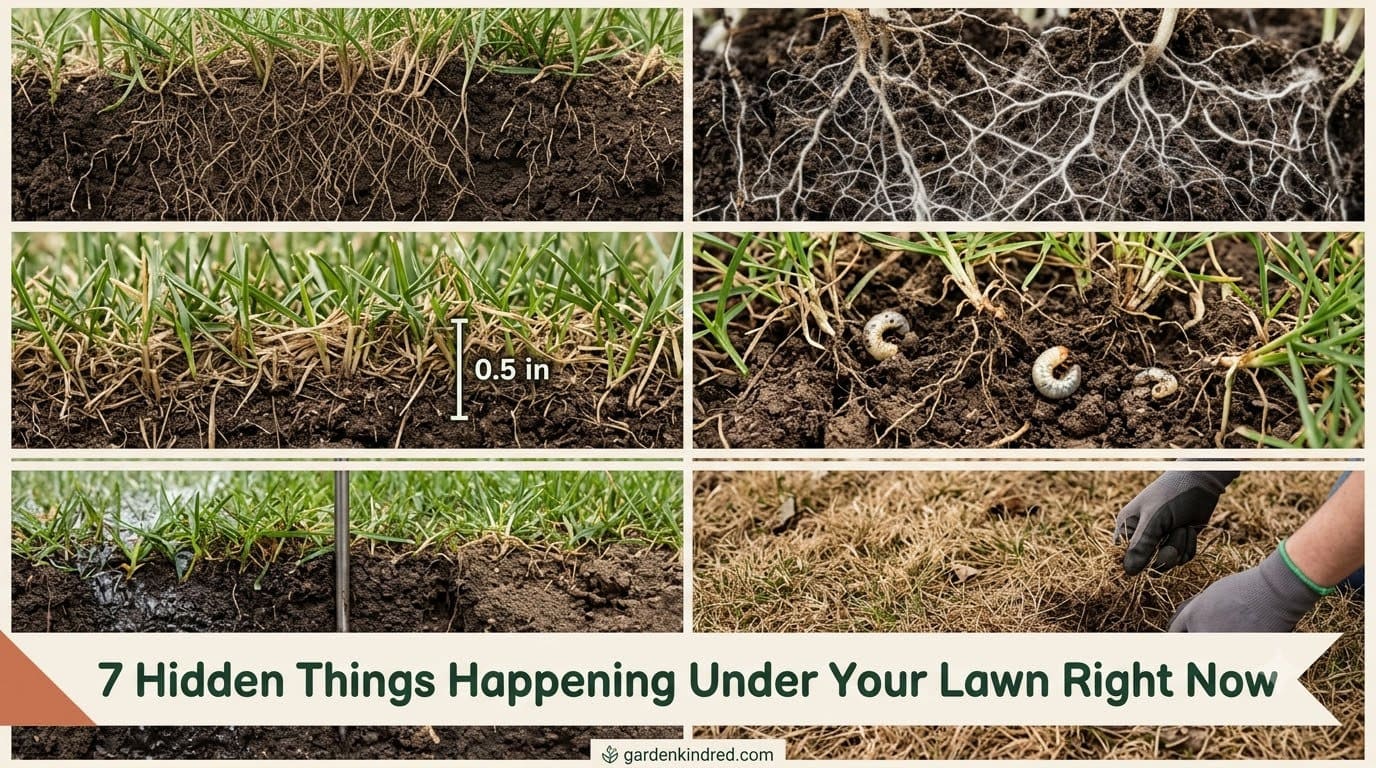
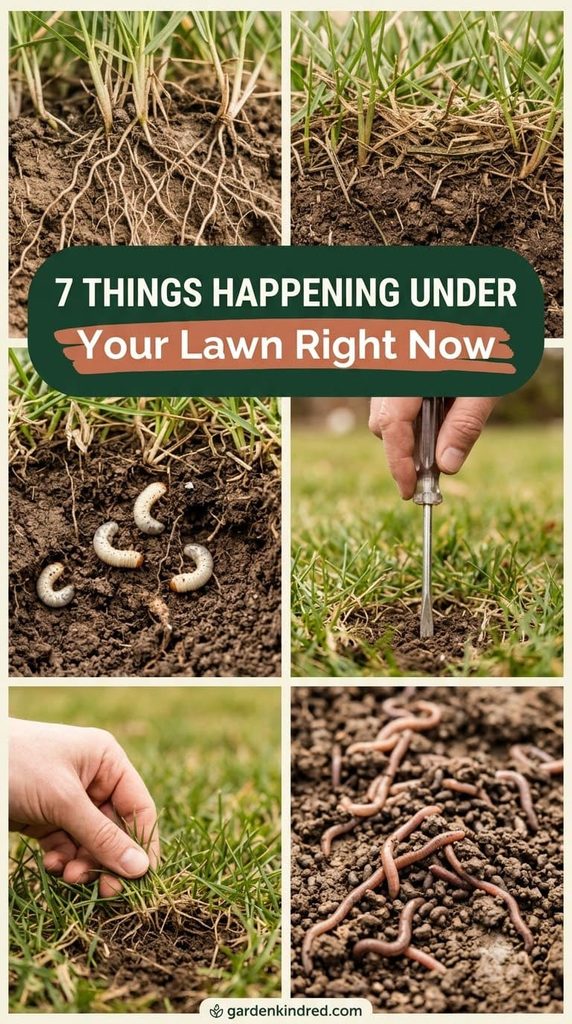
7 Hidden Things Happening Under Your Lawn Right Now
Under every quiet, ordinary lawn is a working root network, a fungal trading post, and a colony of decomposers you’ve never met. Here’s what’s actually going on down there.
Never miss an update — choose Garden Kindred as your preferred source on Google.
How it works: Tap the button below to open Google’s settings page, then check the box next to Garden Kindred.
Tap the checkbox to turn it blue — that’s how you know it’s set.
Quick Answer: Under an average lawn, grass roots extend 6 inches to 3 feet depending on species and mowing height, a fungal network of mycorrhizal hyphae stretches up to 24 inches past each root tip trading nutrients for sugar, and a thatch layer under 1/2 inch protects the soil while anything thicker starves it of water and air. Beneficial soil life, bacteria, fungi, earthworms, and up to 6-10 grubs per square foot, is normal and often helps the lawn rather than harming it. The tug test (grab a clump near the soil line and pull gently) tells you in seconds whether brown grass is dormant (resists, stays rooted, white living roots) or actually dead (comes up loose with little resistance, brittle gray roots). Mowing height, watering depth, and thatch thickness are the three variables a homeowner can actually control down there. Most of what determines whether a lawn thrives or struggles happens below the mower line, not above it, and none of it requires guesswork once you know what to check.
You mow it, you water it, you maybe yell at the neighbor’s dog about it. But the actual work of keeping a lawn alive happens in a zone you never look at: the top 6 to 12 inches of soil under the blades.
Down there right now, roots are competing for space, a fungal network is trading sugar for phosphorus, and something is probably eating a root or two. None of it is visible from a lawn chair. Most of it is exactly why your lawn looks the way it does.
I got curious about this after staring at a patch of my own yard that looked dead in July and came back fine by September, and it turns out the answer was never on the surface. It was underground the whole time. This is a walk through what’s actually happening down there, section by section, plus what to actually do about each one.
1. Your grass roots are engineering their own depth, not just growing
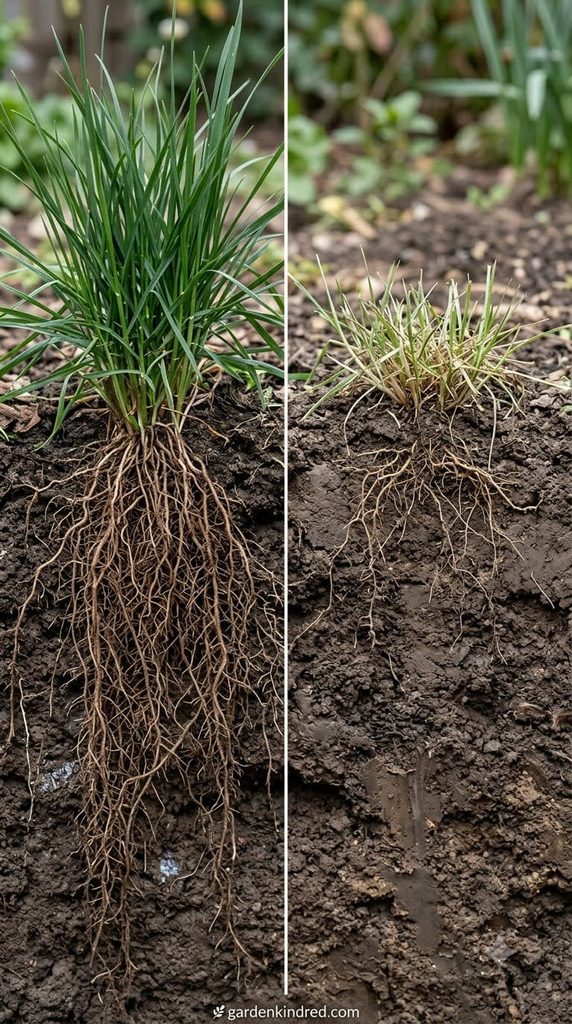
Grass roots don’t grow to some fixed depth. They respond, in real time, to how you treat the top of the plant.
According to NC State University Cooperative Extension, severe defoliation (cutting off more than a third of the blade in one pass) can shrink root depth by several inches within just a few weeks. The plant redirects energy into rebuilding leaf tissue and simply stops investing in roots until the canopy recovers.
Kansas State University formalizes this as the one-third rule: never remove more than a third of the blade height in a single mow. Violate it regularly and root growth can stall entirely while the plant scrambles to regrow leaf area.
Species matters too. Tall fescue can push roots 2 to 3 feet deep in loose soil, while most cool-season lawns (Kentucky bluegrass, perennial ryegrass, fine fescue) stay under 18 inches even in ideal conditions, per the same NC State data. Warm-season grasses like bermudagrass often root shallower still, but spread laterally through stolons instead.
The mechanism is simple: a taller blade means more leaf surface for photosynthesis, which means more sugar available to send downward into root growth. Scalp the lawn and you cut the plant’s own supply chain.
What to actually do: raise your mower deck. Cool-season lawns do best mowed at 3 to 3.5 inches, warm-season lawns at 1.5 to 2.5 inches depending on species, per Clemson Cooperative Extension’s Home & Garden Information Center. Check your deck height with a tape measure against the actual blade tips, not the dial number, decks drift out of calibration. And never mow more than a third off in one pass. If growth got away from you, mow it down in two sessions a few days apart instead of scalping it in one.
2. A fungal network wider than your yard is already trading nutrients for sugar
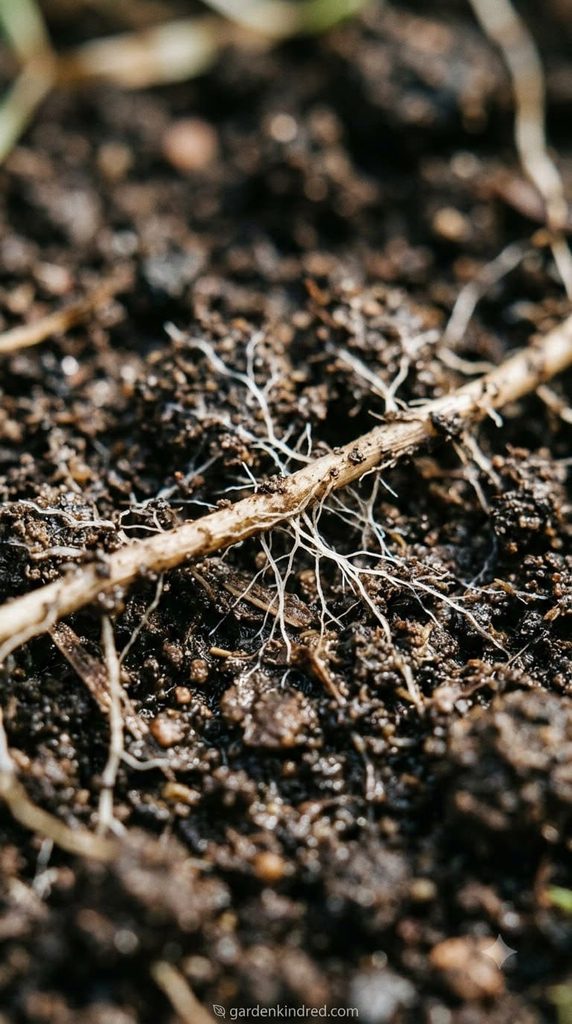
Under a healthy lawn, grass roots aren’t working alone. Threadlike fungal filaments called hyphae, part of mycorrhizal fungi, physically attach to the roots and extend the plant’s reach into the soil.
Per Pennington’s turf research summary citing university turf studies, these hyphae are roughly one-tenth the diameter of a root hair, which lets them slip into soil pores roots physically can’t reach, and they can extend up to 24 inches beyond the root they’re attached to.
The trade is direct: the fungus pulls phosphorus, micronutrients, and water from soil the roots can’t access, and in exchange the grass plant feeds it sugar produced through photosynthesis. It’s a functioning economy, not a metaphor. Turf studies referenced by LebanonTurf’s agronomy team link mycorrhizal colonization to measurably better drought tolerance and disease resistance in turfgrass.
The catch: this network is fragile. Tilling, heavy grading, soil compaction, and stripping topsoil during construction all significantly reduce mycorrhizal populations, and a new lawn on disturbed or graded soil often has almost none until the fungal colonies rebuild over one to several growing seasons.
What to actually do: stop tilling or aerating more aggressively than the lawn needs, every pass through the soil disrupts fungal threads that took a season to build. If you’re seeding a new lawn on graded or construction soil, a mycorrhizal inoculant applied at seeding gives the network a head start instead of waiting for it to colonize on its own. Avoid broad-spectrum fungicide unless you’re treating a confirmed disease, since it doesn’t distinguish beneficial fungi from harmful ones.
3. The thatch layer under your feet is either buffering your lawn or slowly strangling it
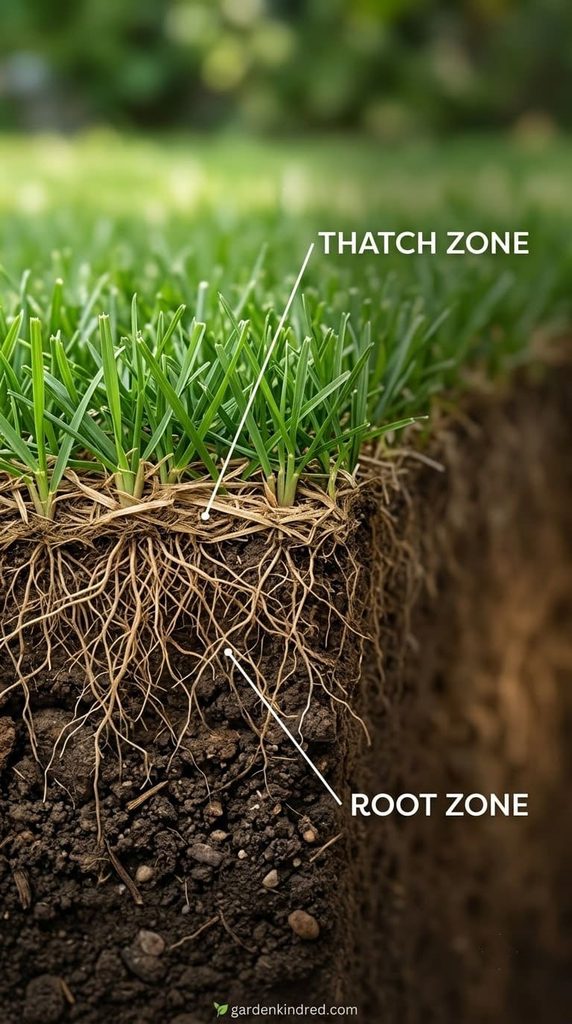
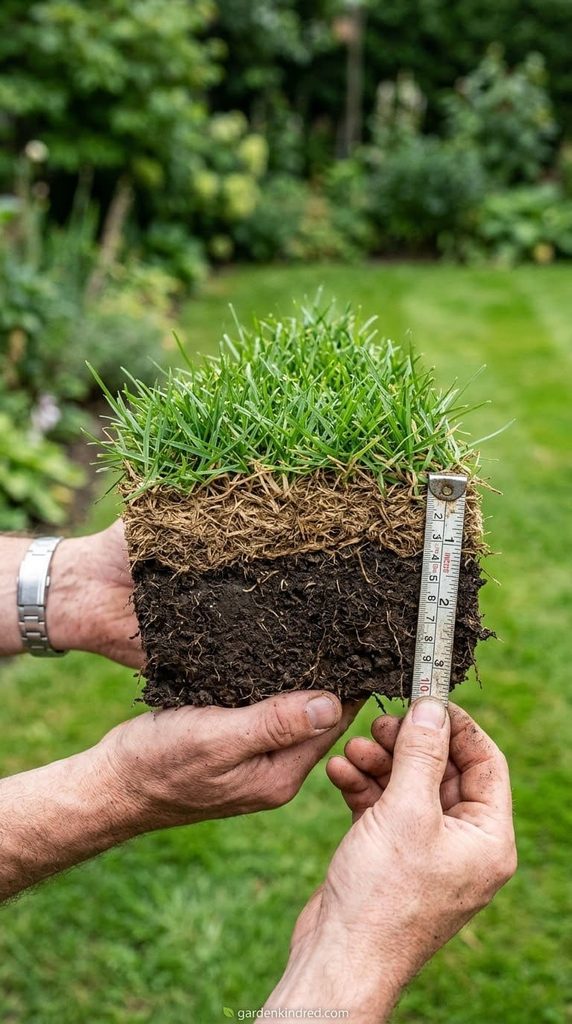
Thatch, the tightly woven layer of dead and living stems, roots, and organic debris between the soil surface and the green blades, sounds like something to remove on sight. It isn’t, until it crosses a specific thickness.
According to Oklahoma State University Extension, a thatch layer under about 1/2 inch is actually beneficial: it buffers soil temperature swings, holds moisture, and cushions foot traffic. University of Minnesota Extension gets more specific by grass type: cool-season lawns (fescue, bluegrass, ryegrass) start having problems past 1/3 inch, while warm-season lawns (bermudagrass, zoysiagrass, buffalograss) can tolerate up to 1/2 inch before trouble starts.
Past that threshold, the mechanism flips. Illinois Extension explains that thick thatch blocks water, nutrients, and pesticides from reaching actual soil, and because thatch itself dries out fast and resists rewetting, it can force roots to grow into the thatch layer instead of into soil, a shallow, drought-vulnerable root system disguised as a lush green lawn on top.
What to actually do: check your own thatch depth before assuming you need to dethatch. Cut a pie-shaped wedge of turf about 3 to 4 inches deep with a garden knife or trowel, and measure the tan, spongy layer between the green blades and the brown soil. If it’s under 1/2 inch (or 1/3 inch for cool-season lawns), leave it, it’s doing its job. If it’s over that, core aerate in early fall (cool-season) or late spring (warm-season) rather than power-raking, which is more aggressive than most lawns need. Excess thatch is usually a symptom of overwatering or over-fertilizing with fast-release nitrogen, so address that cause too, not just the symptom.
4. Something is eating roots down there, and 8 per square foot is the number that matters
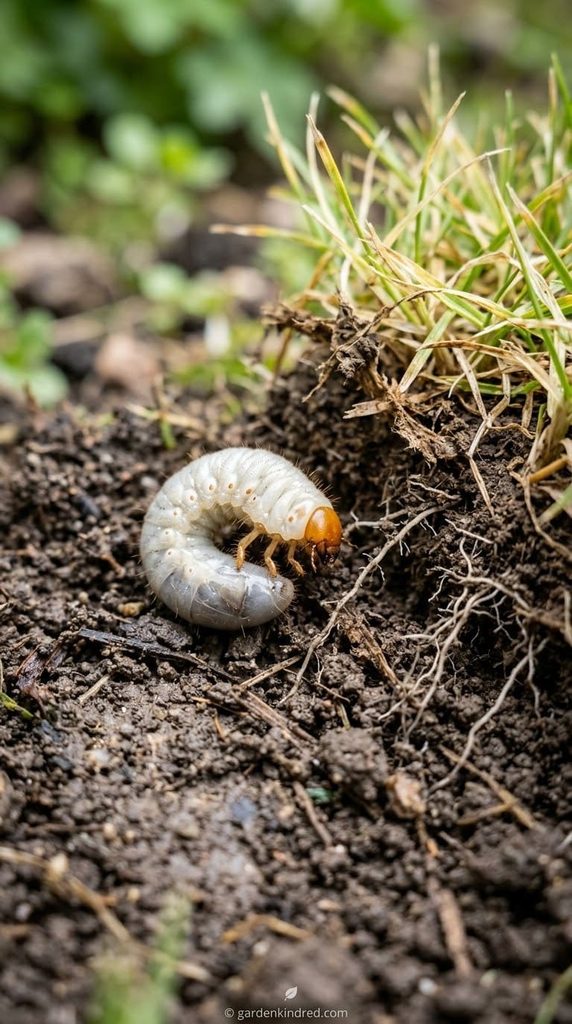
Grubs, the C-shaped larvae of Japanese beetles, June beetles, and masked chafers, live in the top few inches of soil and eat grass roots from below. A few are always present and mostly harmless.
Per University of Nebraska-Lincoln Extension in Lancaster County, one or two grubs per square foot is normal background presence and needs no treatment. The trouble threshold, according to Clemson HGIC, sits around 8 to 10 grubs per square foot for Japanese beetle and masked chafer larvae specifically, though healthy, unstressed turf can often tolerate up to 10 before visible damage shows, while stressed or poorly maintained turf can show damage at 5 to 7.
The mechanism is direct root severance: grubs chew through the root system that anchors and feeds the grass plant, so above-ground symptoms (irregular brown patches that pull up like loose carpet, with no resistance) are really a root-loss problem wearing a discoloration disguise.
What to actually do: before treating for grubs, confirm the count. Cut a 1-square-foot section of turf about 2 inches deep on three or four spots around the yard, fold it back, and count grubs by hand. Only treat if you’re consistently at or above 8-10 per square foot, treating a healthy lawn with only 1-2 grubs wastes product and kills beneficial soil insects along with the pest. If you’re over threshold, curative treatments (containing trichlorfon or carbaryl) work on grubs already present, while preventive treatments (containing imidacloprid or chlorantraniliprole) need to go down before egg-laying season in early-to-mid summer, check your local extension office’s timing since it shifts by region and grub species.
5. Roots are chasing water and dodging heat on a schedule you can’t see
Soil temperature and moisture change with depth on their own timeline, several hours to days behind air temperature, and grass roots are constantly adjusting position to chase both.
The soil food web itself depends on this: per Piedmont Master Gardeners’ summary of soil biology research, bacteria and fungi break down organic matter fastest in a specific moisture-and-temperature band, too dry or too cold and microbial activity slows dramatically, which slows the whole nutrient cycle grass roots depend on.
This is also why watering depth matters more than watering frequency. Shallow, frequent watering keeps moisture in the top inch or two of soil, which trains roots to stay shallow instead of growing down to find water on their own, exactly the same shallow-root problem caused by scalping. Deep, infrequent watering does the opposite: it forces roots to grow down toward where the water actually is.
What to actually do: water deeply and infrequently rather than a light daily sprinkle, most lawns do well with about 1 to 1.5 inches of water per week total (rainfall included), applied in one or two sessions rather than five short ones. Water early morning, not evening, so blades dry before nightfall instead of sitting wet overnight (a fungal disease risk, not a root issue, but worth doing right anyway). To check if you’re actually watering deep enough, push a screwdriver into the lawn after watering, it should slide in easily to at least 6 inches. If it stops short, you’re not getting water deep enough to reach the root zone that matters.
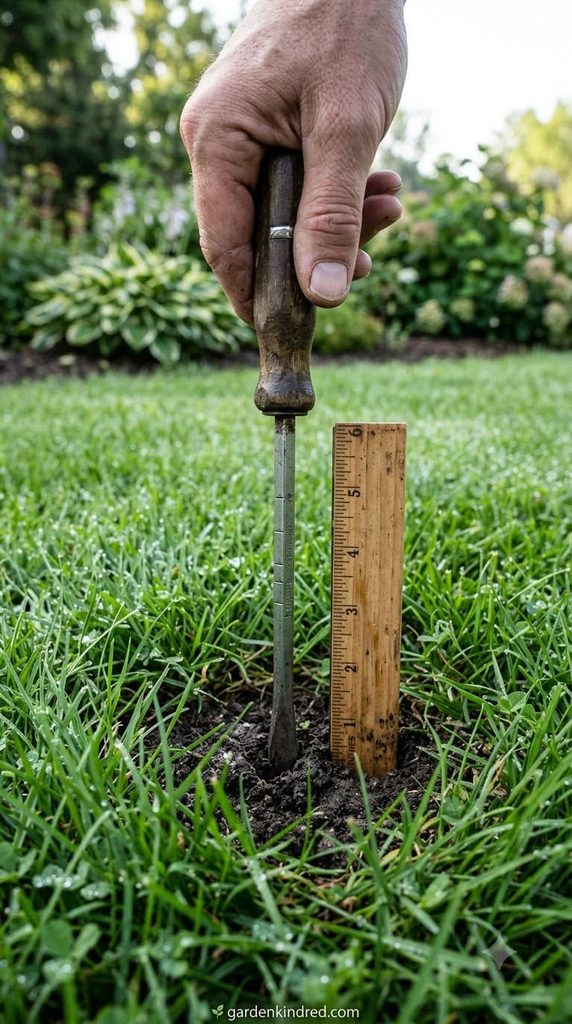
6. Brown doesn’t mean dead: the difference is happening at the crown, not the blade
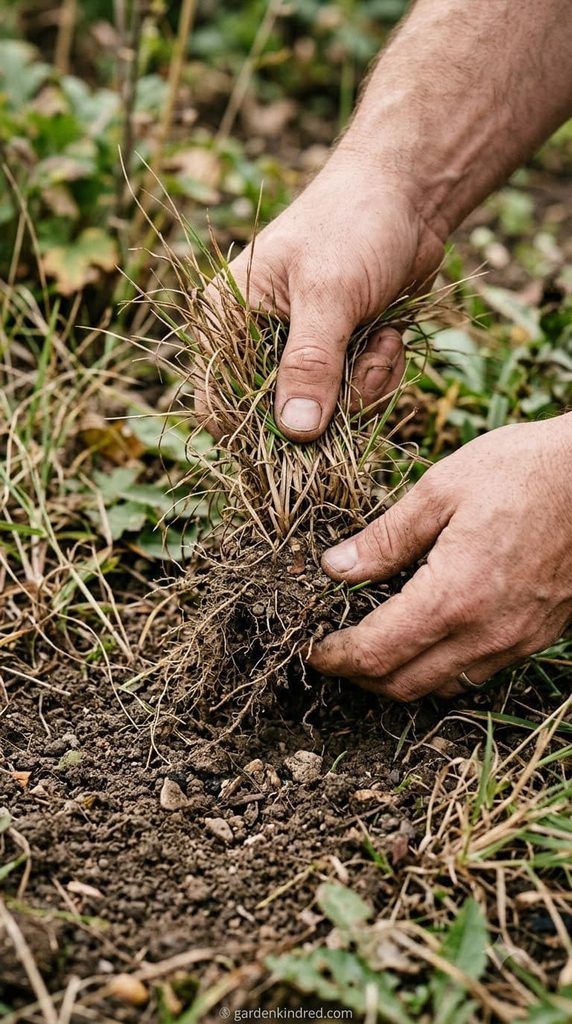
When a lawn goes uniformly brown in a drought or a hard frost, most homeowners assume the worst. Usually they’re wrong, and the real answer is happening at the crown, the growing point where blade meets root, just below the soil surface.
Grass has a survival strategy: under drought or extreme cold stress, it sacrifices the visible blade tissue first and redirects whatever resources it has left to keeping the crown alive. The blade browns and looks dead. The crown, if it’s still alive, isn’t.
The distinction is testable in seconds. Per multiple turf-care sources cross-referencing standard agronomy practice, grab a small clump of the brown grass near the soil line and tug gently upward. If it resists and stays rooted, the crown and root system are alive, that’s dormancy, a real survival state, not damage. If it comes up easily and loose, with little resistance, the root system has actually failed, that’s death, not dormancy. A secondary check: dig up a few roots and look at them directly. White, flexible roots mean the plant is alive and dormant. Brittle, gray-brown roots mean it’s dead.
Dormant grass also tends to brown uniformly across the whole lawn, following the same stress evenly. Dead grass, by contrast, more often shows up in patches or irregular spots, since whatever killed it (grubs, disease, dog urine, a scald from a hot mower) rarely hits a lawn with perfect uniformity.
What to actually do: before reseeding or panicking over a brown lawn, run the tug test on 4-5 spots around the yard, not just one. Dormant cool-season lawns can survive 4-6 weeks without water in most climates and green back up within 2-3 weeks once regular moisture returns, per general turf agronomy practice, so resist the urge to reseed a lawn that’s simply dormant, you’d be spending money and disturbing a lawn that was going to recover on its own. Only reseed the sections that failed the tug test.
7. Earthworms are quietly rebuilding your soil structure one casting at a time
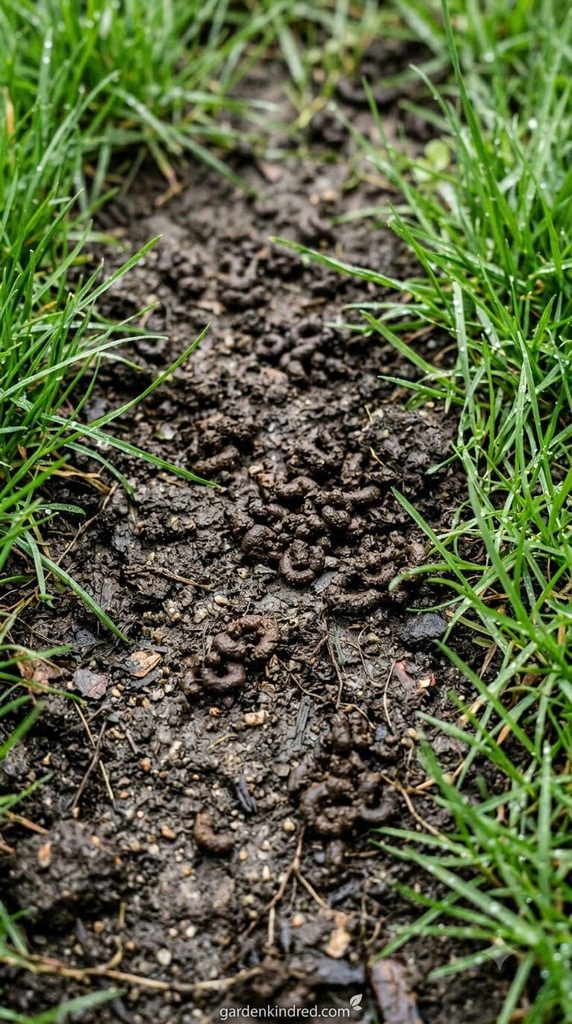
Earthworms are the one piece of underground lawn biology most people actually notice, usually as castings on the surface after rain. What they’re doing below is more useful than most people realize.
According to research cited by Ohio State University and summarized across multiple turf-soil sources, earthworm activity directly builds soil aggregation (soil particles binding into stable clumps), which improves water infiltration and reduces compaction over time as worms tunnel and mix organic matter through the soil profile.
Their castings do more than just improve structure. Research at North Carolina State University found that soil enriched with earthworm castings increases plants’ production of chitinase, an enzyme that breaks down the outer shell of many insects that feed on plant tissue, meaning active earthworm populations are indirectly linked to better pest resistance, not just better soil texture.
A single earthworm tunnel is a small thing. A healthy population working continuously through a lawn’s soil profile is a slow-motion tilling and fertilizing operation running for free, every day, without a machine.
What to actually do: earthworm populations respond directly to what you do on the surface. Avoid broad-spectrum insecticides applied preventively across the whole lawn, they don’t distinguish grubs from earthworms. Leave grass clippings on the lawn after mowing (a light layer breaks down fast and feeds the exact organic matter earthworms eat) instead of bagging every cut. If you see very few castings and a lawn that stays hard and compacted even after rain, that’s a signal worth testing your soil for compaction and organic matter, both of which core aeration and reduced chemical use over a season or two typically improve.
How to check what’s happening under your own lawn (without guessing)
You don’t need a lab to get a real read on your lawn’s underground condition. Four checks, in order of how fast they are:
| Check | What it tells you | How long it takes |
|---|---|---|
| Tug test | Dormant vs dead grass | 10 seconds |
| Thatch wedge cut | Whether thatch is protective or harmful | 5 minutes |
| Grub count (1 sq ft, 2 inches deep) | Whether grub damage is likely | 10 minutes |
| Soil test kit (pH + N-P-K) | Whether nutrients or pH are limiting root growth | 10 minutes plus wait time |
Run these before spending money on fertilizer, dethatching, or grub treatment you may not need. Every one of the sections above points back to one of these four checks.
Frequently asked questions
How deep do grass roots actually go?
It depends on species and mowing height. Cool-season lawns like Kentucky bluegrass and perennial ryegrass typically stay under 18 inches even in good conditions, while tall fescue can reach 2 to 3 feet in loose, unrestricted soil, per NC State University Extension data. Mowing height is the biggest controllable factor: taller mowing consistently produces deeper roots.
Is a thick thatch layer always bad?
No. A thatch layer under about 1/2 inch (1/3 inch for cool-season grasses) is beneficial, it buffers temperature and moisture swings. Problems start once it grows past that threshold, when it blocks water and nutrients from reaching soil and pushes roots to grow into the thatch itself instead of into soil.
How many grubs per square foot means I need to treat my lawn?
Most extension sources put the treatment threshold around 8-10 grubs per square foot for the most common species (Japanese beetle, masked chafer), though healthy turf can sometimes tolerate slightly more and stressed turf can show damage at 5-7. One or two grubs per square foot is normal and not worth treating.
How do I know if my brown lawn is dormant or dead?
Grab a clump of grass near the soil line and tug gently upward. If it resists and stays rooted, it’s dormant and alive. If it pulls out easily with little resistance, the roots have failed and that section is dead. Dormant grass also browns uniformly across the lawn, while dead grass tends to show up in patches.
Related Posts
- Pre-Emergent vs. Post-Emergent Weed Killer: The Real Fall Timing Answer for Clay Soil Lawns
- 7 Tested Fall Lawn Fertilizers That Hold Up on Windy Sites
- 7 Best Grass Seed Types for Fall Planting by Region for Cold Climates
Never miss an update — choose Garden Kindred as your preferred source on Google.
How it works: Tap the button below to open Google's settings page, then check the box next to Garden Kindred.
Tap the checkbox to turn it blue — that's how you know it's set.