7 Plants You Should Never Prune in Fall on Windy Sites
Fall pruning feels productive, but on a windy lot it can strip the exact wood, flower buds, or crown cover your plants actually need to survive the coldest, gustiest months.

Never miss an update — choose Garden Kindred as your preferred source on Google.
How it works: Tap the button below to open Google’s settings page, then check the box next to Garden Kindred.
Tap the checkbox to turn it blue — that’s how you know it’s set.
Quick Answer: On a windy site, skip fall pruning on bigleaf hydrangea, roses, ornamental grasses, butterfly bush, boxwood and other broadleaf evergreens, apple and stone fruit trees, and raspberry or blackberry canes. Fall cuts either remove next year’s flower buds (hydrangea), delay wound closure into the exposed wind season by about 20 percent per Mississippi State University Extension, or push tender new growth that wind desiccates before it ever hardens off for winter. On an exposed lot that regrowth can die within days of a hard gust, well before frost is even the main threat, since wind pulls moisture out of soft tissue faster than roots in cooling soil can replace it. The one exception is safety pruning: dead, broken, or storm-torn wood should come off right away, on any of these plants, regardless of season, since a torn branch invites disease faster than a clean cut ever would. Everything else waits for late winter or immediately after bloom, per K-State Research and Extension.
I made this mistake myself two Octobers ago. I had a Saturday free, the wind wasn’t bad yet, and I went at a butterfly bush and a row of raspberry canes with the same pair of loppers like it was one job. The raspberries were fine. The butterfly bush pushed a flush of soft new shoots three weeks later during a warm spell, and every one of them was black mush by Thanksgiving.
That’s the trap with fall pruning on a windy lot specifically. It’s not just about cold. A cut plant tries to heal and regrow at the exact moment it should be shutting down and moving sugars into its roots, and that regrowth has thin cell walls with almost no wax cuticle. Put that tissue in 20 mph gusts with low humidity and it loses water faster than the roots can replace it, even if the thermometer never drops below freezing.
Below are the 7 plants where this mechanism actually plays out, why each one fails differently, and when to prune instead so you don’t lose flowers, fruit, or whole canes. Two habits carry across all seven: put the loppers away once nighttime lows are consistently hitting the 40s in your zone, and if you’re not sure whether a stem is dead or just dormant, scratch a thumbnail-width patch of bark near the base and check for green underneath before you cut anything.
1. Bigleaf and oakleaf hydrangea
Bigleaf hydrangea (Hydrangea macrophylla) and oakleaf hydrangea (Hydrangea quercifolia) set next year’s flower buds on the current season’s wood by late summer, months before you’d ever think to prune. Cut that wood back in fall and you’re not risking winter injury, you’re removing the flowers outright.
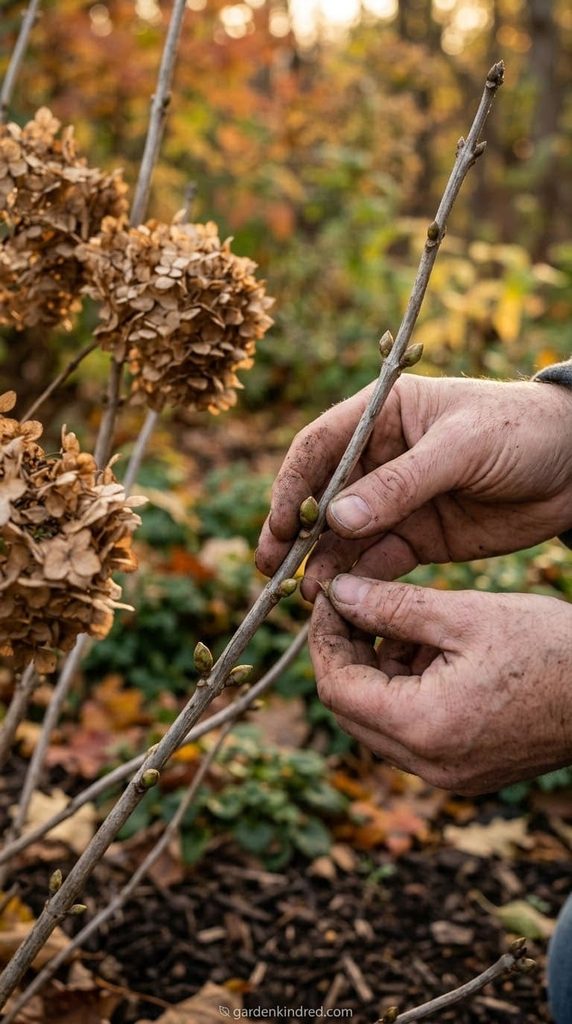
According to University of Maryland Extension, old-wood bloomers should be pruned in late winter to very early spring, just before new growth starts, or immediately after the summer bloom fades if you’re shaping rather than renovating. On a windy site the risk compounds: any stub left from a fall cut sits exposed all winter with no leaf canopy to buffer gusts around the crown, which increases desiccation at the wound edge even though the plant itself survives.
The fix costs nothing. Leave the stems alone through fall, deadhead spent blooms if you want tidiness, and save real pruning for when you can see which buds actually made it through winter. In late winter, walk each stem from the base up and check for a plump, green-tipped bud, then cut just above the highest live one and remove only the bare wood above it, since anything higher is dead weight that will never flower. If you’re mulching for winter protection on an exposed site, pile 3 to 4 inches of shredded leaves or bark loosely over the crown after the first hard frost, then pull it back in early spring once new growth starts, so the mulch buffers root-zone cold without smothering the buds you just protected.
2. Roses, when it’s more than a light tip-back
Roses split into two very different fall tasks, and conflating them is the actual mistake. A light trim to about 30 inches, cutting the tallest canes so wind can’t rock the root ball loose, is a legitimate and recommended fall task per the University of Maryland Extension rose pruning guide. Hard shaping pruning, the kind that cuts canes down to a few buds, is not.
Heavy fall cuts stimulate exactly the tender regrowth this article keeps coming back to. On an exposed site that new growth doesn’t just risk frost, it desiccates in the wind within days, and the plant enters winter with open wounds and no time to callus over before hard freezes hit.
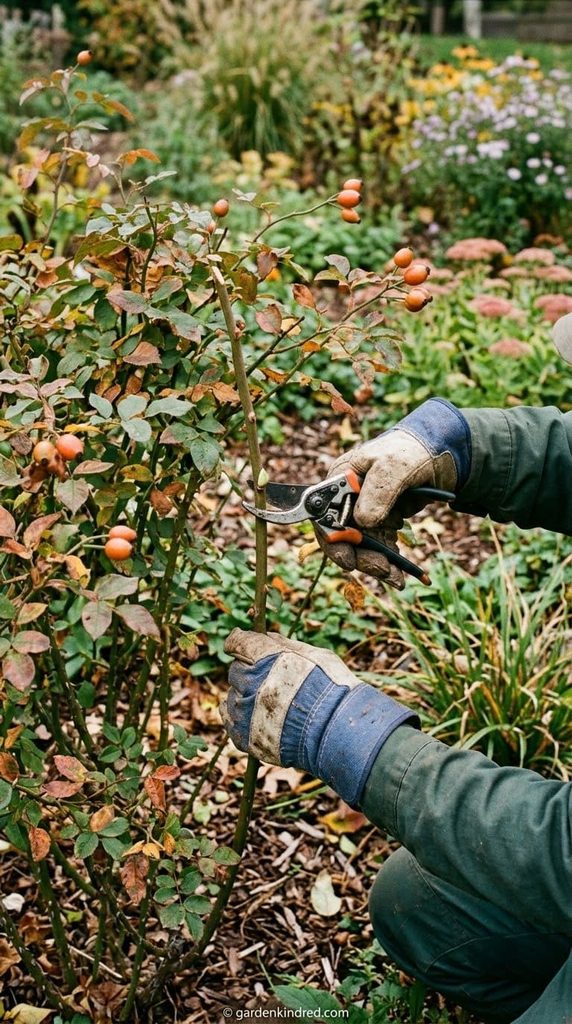
Do the wind-safety trim (tallest canes only, roughly one-third shorter) in fall. Cut just above an outward-facing bud at an angle so water sheds off the cut instead of pooling on it, and only shorten canes that are actually rocking visibly in wind, not every cane on the bush. Save real shaping pruning for late winter or early spring, right before new growth emerges, when the plant can heal fast instead of sitting exposed for months. A simple field test: if you can rock the base of the plant with one hand in a moderate gust, it needs the fall trim. If the root ball stays put, skip pruning entirely and just mulch the base 2 to 3 inches deep for winter.
3. Ornamental grasses
This one runs backward from what feels tidy. Cutting an ornamental grass clump to the ground in October looks clean, but the standing foliage is doing structural work you can’t see: it insulates the crown, and it physically sheds rain and snow away from the center of the plant.
Remove that canopy on a windy site and two things happen. First, the crown loses its wind buffer and is exposed directly to desiccating gusts through the coldest months. Second, and more damaging, University of Illinois Extension notes that cutting grasses back allows water to reach the crown directly and pool there, and pooled moisture at a wind-chilled crown is what actually kills the plant over winter, not the cold air alone.

Leave grasses standing through winter. Cut back in late winter to early spring, February through March in most zones, right before new blades emerge from the base. When you do cut, bundle the foliage first with twine or a bungee cord about a third of the way up the clump, then cut below the tie with hedge shears or a pruning saw for thick-stemmed miscanthus. This keeps loose blades from scattering and makes disposal a single armload instead of a rake-up job. Cut to 3 to 4 inches above the crown, never flush to the ground, so you don’t nick the new shoots already forming at the base.

When you do the correct fall task on this list, the wind-safety rose trim, or clearing a storm-damaged branch, a clean bypass cut matters more than usual, since a crushed or ragged cut heals even slower than a fall cut already does. The replaceable blade keeps this pair sharp for the two real pruning windows most of these plants need each year.
Shop NowThis post contains affiliate links. We may earn a commission on qualifying purchases at no extra cost to you.
4. Butterfly bush (buddleia)
Butterfly bush blooms on new wood, meaning this year’s flowers grow entirely from stems produced this same season. That makes spring pruning not just safe but necessary for a good bloom. Fall pruning gets the timing backward.
Per the University of Arkansas Cooperative Extension Service, fall pruning inhibits the natural hardening-off process the stems need to survive winter, and any regrowth it triggers is dramatically more likely to suffer winter kill. On a windy site that regrowth doesn’t get a slow decline, it gets whipped and desiccated within one or two exposed nights, well before frost even becomes the main threat.
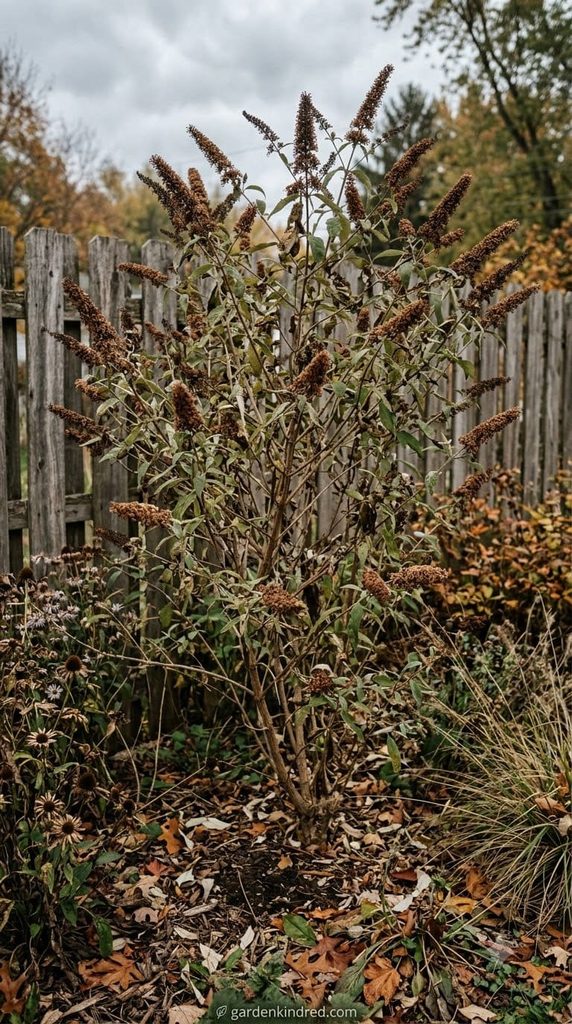
Wait until spring, after the last hard frost but before you see green buds swelling on the stems, then cut hard, down to about 2 feet, using bypass loppers on anything thicker than a pencil so the cut stays clean. If you’re in a colder zone (5 or below), leave the dried stems standing through winter on purpose since they act as extra insulation for the crown. In zone 6 and warmer, a light fall shaping to remove only floppy top growth is fine as long as you leave at least the bottom 18 inches untouched.
5. Boxwood and other broadleaf evergreens
Boxwood, holly, and other broadleaf evergreens keep their leaves through winter, which means they’re transpiring water through their foliage on every above-freezing day, wind or not. Penn State Extension explains that winter burn happens when leaf tissue loses water faster than frozen roots can replace it, and that water loss accelerates sharply during strong wind even when the air temperature itself isn’t that cold.
Fall shearing works against the plant here in a specific way: it exposes a wider ratio of cut, more-vulnerable surface area to the same wind load, since a freshly sheared face has more open leaf edges per square foot than an untouched canopy. Iowa State’s Managing Winter Injury to Boxwood guide recommends pruning dead or damaged tissue only in spring, after new foliage emerges and you can actually see what didn’t make it.
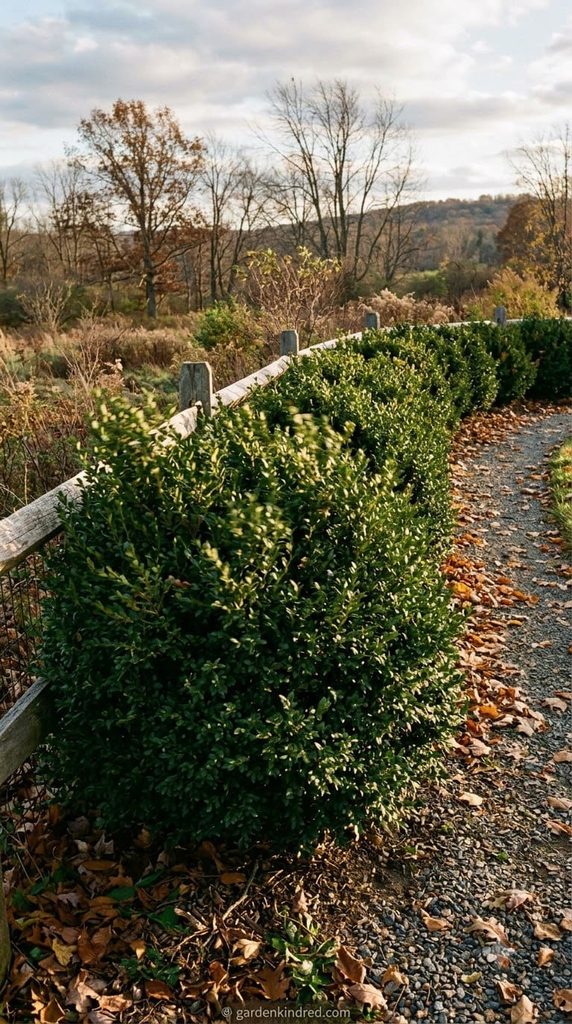
If your soil went into fall dry, water deeply before the ground freezes instead of reaching for pruners. Give the root zone the equivalent of 1 to 2 inches of rain, roughly 30 to 60 minutes with a soaker hose circled around the drip line, and do this once every two to three weeks in fall if rainfall has been under an inch a week. Wrapping exposed plants in burlap on the windward side, staked a few inches off the foliage rather than pressed against it, adds a physical wind break without trapping moisture against the leaves. That single watering step does more for winter survival on an exposed site than any amount of fall shaping.
6. Apple and stone fruit trees
Fruit trees are the clearest wound-mechanics case on this list. Mississippi State University Extension has measured that pruning wounds made in fall close about 20 percent slower than wounds made at other times of year, because wood water content is already dropping as the tree moves into dormancy and the callus tissue that seals a cut simply can’t form as fast in cooling, drying wood.
On a sheltered site a slow-closing wound is a cosmetic problem. On a windy site it’s an open door. Every week that cut stays unsealed is another week of wind-driven rain and airborne pathogen spores reaching living tissue, and per University of Vermont Extension, pruning also delays a tree’s own progression into full dormancy at the site of every single cut, right when a sudden cold snap is most likely.
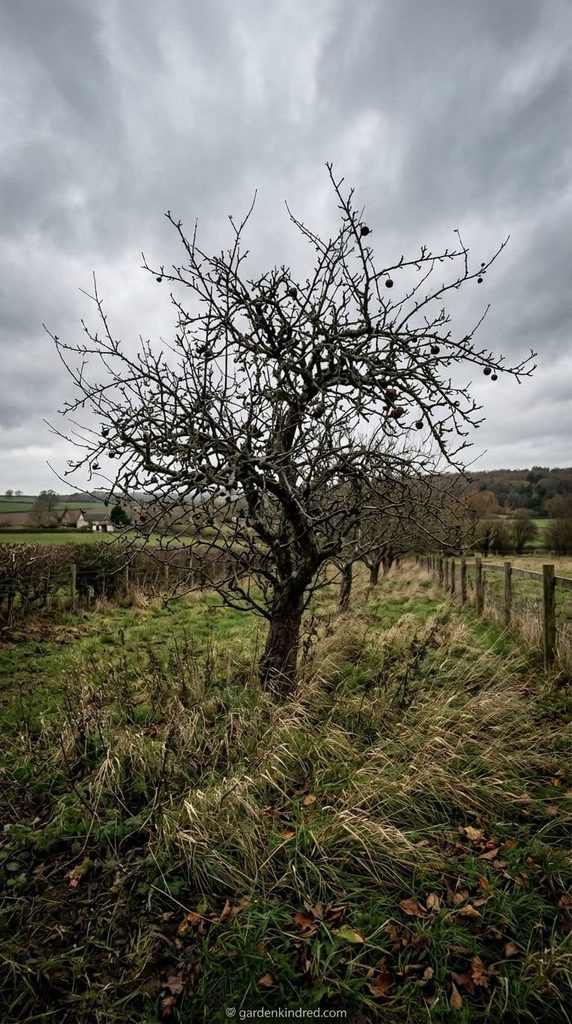
Wait for full winter dormancy, typically late January through March depending on zone, when the tree is fully shut down and wounds close at a normal rate with no active growth left to interrupt. Prune on a dry day above freezing so cuts aren’t sitting wet, and make each cut just outside the branch collar (the slightly raised ring where a limb meets the trunk) at a shallow angle, never flush to the trunk, since flush cuts remove the tissue the tree actually uses to wall off decay. Skip pruning paint or sealant on the cuts. Extension research shows it doesn’t speed healing and can trap moisture against the wound instead.
7. Raspberry and blackberry canes
Removing spent floricanes (the canes that already fruited) at ground level in fall is fine and standard practice. The mistake is topping the remaining canes, cutting healthy first-year canes down to a shorter height, before winter on an exposed row.
Cane length matters for wind mechanics specifically. Oregon State University Extension notes that a proper trellis, not a shortened cane, is what actually reduces wind breakage, because trellised canes flex and distribute wind load across the wire instead of snapping at a single fresh cut point. A cane topped in fall has a raw, unsealed cut sitting at the exact height where wind stress concentrates, and that cut becomes the weak point where the cane splits during a winter storm.
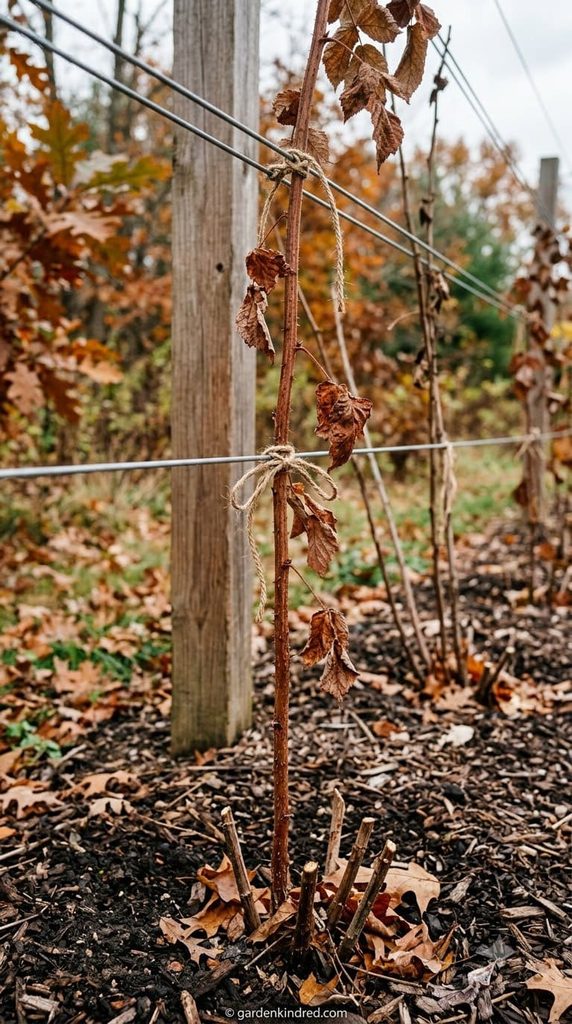
Remove only the spent floricanes at ground level this fall: they’re the canes with peeling, brownish-gray bark and old fruit stubs, easy to tell apart from the smoother green-brown first-year canes you’re keeping. Cut those spent canes flush at the soil line and pull them out rather than leaving stubs. Save topping and height-thinning for late winter, and put up a real trellis on any row exposed to consistent wind, that does more for cane survival than any cut timing choice: a simple two-wire system at 3 and 5 feet, canes tied loosely with soft twine every foot or so, lets the row flex as a unit instead of individual canes taking the full gust load.
Comparison: why fall pruning backfires on each plant
| Plant | What fall pruning removes or triggers | Windy-site failure mode | Correct pruning window |
|---|---|---|---|
| Bigleaf/oakleaf hydrangea | Next year’s flower buds (set on current wood) | Exposed cut stub with no canopy buffer | Late winter or right after bloom |
| Roses (hard pruning) | Triggers tender regrowth | Regrowth desiccates in gusts within days | Late winter/early spring |
| Ornamental grasses | Crown’s own insulation and rain-shedding cover | Moisture pools in wind-chilled crown, rot | Late winter (Feb-Mar) |
| Butterfly bush | Hardened-off tissue, forces regrowth | Regrowth whipped and killed before frost even hits | Early spring, after last frost |
| Boxwood/broadleaf evergreen | Increases cut-leaf-edge surface area | Faster transpiration water loss in wind | Spring, after new foliage shows |
| Apple/stone fruit trees | Normal wound-closure rate (20% slower in fall) | Open wound exposed to wind-driven pathogens for weeks | Full dormancy (late Jan-Mar) |
| Raspberry/blackberry canes | Cane’s full flex length | Fresh cut point becomes the wind-snap point | Late winter, plus add a trellis |
Frequently asked questions
Is it ever okay to prune in fall on a windy site?
Yes, for one category only: dead, broken, storm-damaged, or diseased wood. Removing a cracked branch or a cane already torn by wind is a safety cut, and it doesn’t trigger the same tender regrowth response as a shaping or renovation cut. Everything else on this list waits for its correct window.
My hydrangea already lost its leaves. Isn’t it dormant enough to prune now?
Losing leaves and reaching true dormancy aren’t the same thing. The flower buds for next year are already formed and sitting on the wood you’d be cutting, regardless of whether leaves have dropped. Wait until you can see which buds survived winter before you prune.
Will one fall pruning mistake actually kill the plant?
Usually not outright. Most of these plants survive a wrongly timed cut, they just skip a bloom cycle (hydrangea, butterfly bush) or lose more wood to winter injury than they would have otherwise (boxwood, fruit trees). The raspberry and rose cases are the ones most likely to cause real cane loss on a genuinely windy site, since the wind-snap risk is mechanical, not just physiological.
What should I actually do in fall on a windy site instead of pruning?
Run this as a short checklist, in order. First, water deeply (1 to 2 inches) before the ground freezes if fall rainfall has been under an inch a week, especially for evergreens. Second, mulch root zones 2 to 4 inches deep once the first hard frost hits, keeping mulch a couple inches back from stems and trunks. Third, do the wind-safety trims described above (roses, storm-damaged wood). Fourth, stake or burlap-wrap anything newly planted or visibly rocking in gusts, and put up trellising for brambles. Then leave everything else alone until its correct dormant-season or post-bloom window.

Products We Recommend
This post contains affiliate links. We may earn a commission on qualifying purchases at no extra cost to you.
Felco F2 Swiss Bypass Pruning Shears
When you do the correct fall task on this list, the wind-safety rose trim, or clearing a storm-damaged branch, a clean bypass cut matters more than usual, since a crushed or ragged cut heals even slower than a fall cut already does. The replaceable blade keeps this pair sharp for the two real pruning windows most of these plants need each year.
Shop Now
Wilt-Pruf Original Anti-Desiccant Spray, 32 oz
This is the direct fix for the boxwood and broadleaf-evergreen mechanism in section 5, it forms a clear film over foliage that slows transpiration water loss, which is exactly what a windy site needs since the wind, not just cold, is what drives winter burn.
Shop now
AlpineReach Burlap Fabric Roll, 1.3 ft x 30 ft
Wrap this around exposed boxwood, young fruit trees, or any evergreen on the windward side of your property instead of reaching for pruners in fall. It physically blocks the wind load that this whole article is about, without cutting anything.
Shop nowNever miss an update — choose Garden Kindred as your preferred source on Google.
How it works: Tap the button below to open Google's settings page, then check the box next to Garden Kindred.
Tap the checkbox to turn it blue — that's how you know it's set.