Complete Guide to Dividing Perennials in Fall: 9 Rules (Plus What to Never Split)
Some of your perennials are begging to be split into free plants, others will die if you touch them. Here’s how to tell which is which by root type before you grab the spade.

Never miss an update — choose Garden Kindred as your preferred source on Google.
How it works: Tap the button below to open Google’s settings page, then check the box next to Garden Kindred.
Tap the checkbox to turn it blue — that’s how you know it’s set.
Fall division works because most perennials are shifting energy from top growth into root storage, so a cut root ball spends the next four to eight weeks rebuilding roots instead of also trying to push leaves, the same mechanism behind why cooler soil reduces transplant shock.
Divide fibrous-rooted perennials like hostas and daylilies, rhizome plants like bearded iris, and crown/tuber plants like peonies four to six weeks before your ground typically freezes, per Virginia Cooperative Extension and Iowa State University Extension guidance.
Not everything tolerates it. Oriental poppy, milkweed, and other single-taproot plants have no natural division point, and cutting them usually kills both halves rather than making two plants. Ornamental grasses can go either way, cool-season types handle an early fall split, warm-season types are safer left for spring.
Each division needs a real chunk of live roots and at least one growing point, division size and eye count matter as much as timing. Water and mulch immediately after, that’s what actually gets a division through its first winter.
Why does fall actually work better for dividing most perennials?
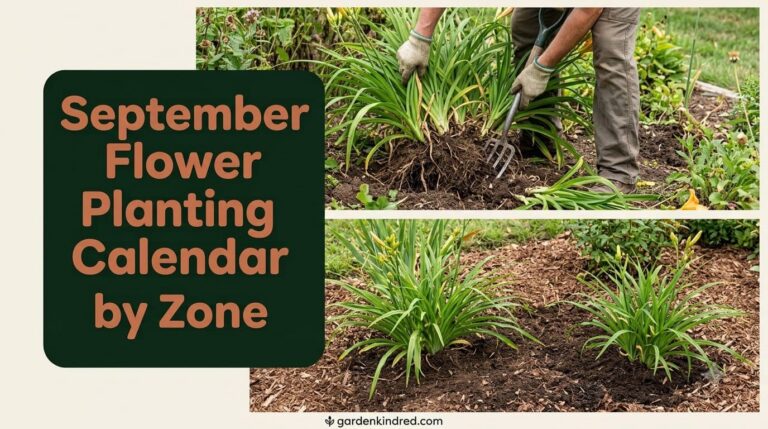
I’ve reworked the same overgrown daylily bed in my own yard three Septembers running now, and every time the roots come up looking the same way, pale, dense, and clearly still working even though the top growth has started to brown off. That’s not an accident.
Most perennials spend late summer through fall doing something called photosynthate reallocation, shifting sugars produced by leaves down into roots and crowns for winter storage, rather than pushing new top growth. University of Vermont Extension explains that spring and fall are the two windows that work for most perennial division, precisely because the plant isn’t in active bloom or heavy top-growth mode, so a division wastes less stored energy re-growing leaves it doesn’t need yet.
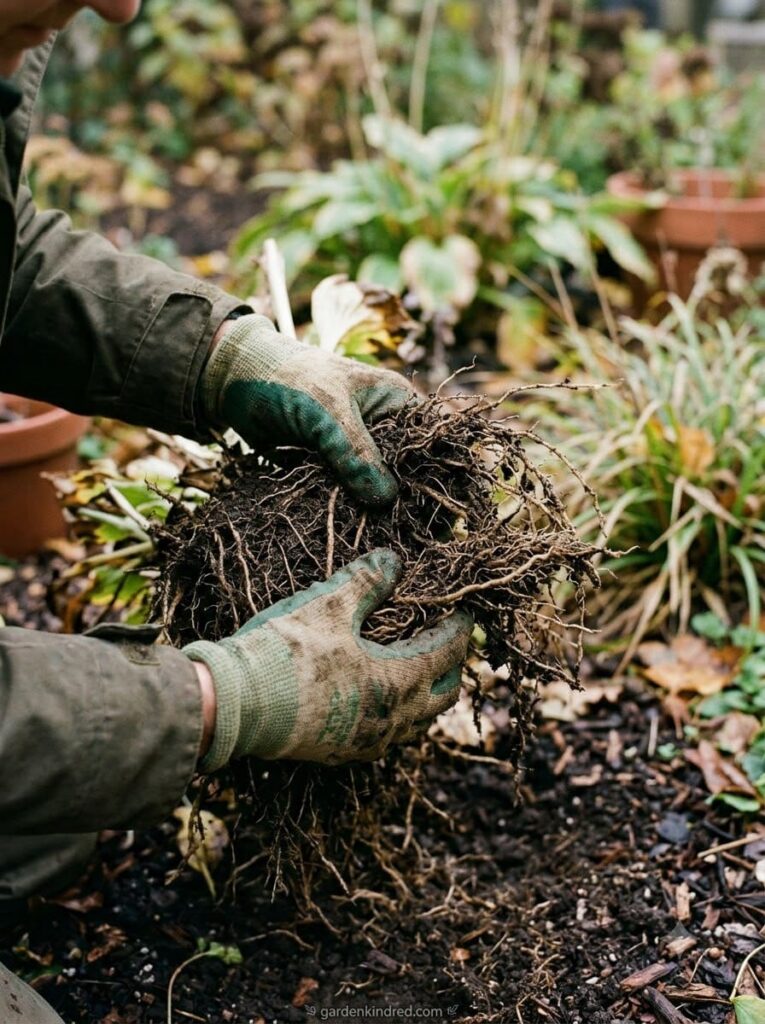
Cutting a root ball is a genuine wound. SDSU Extension notes that cool, wet fall weather reduces water loss through the leaves right when the plant can least afford it, so a division loses less moisture through transpiration while it’s rebuilding a functional root system. Do the same cut in July heat and the plant is fighting two problems at once, a damaged root system and high evaporative demand from the leaves above it.
There’s a specific timing window behind the general “do it in fall” advice, and it isn’t a rounding buffer. Iowa State University Extension puts it at dividing perennials in September and October so roots have enough time to establish before winter dormancy sets in. Four to six weeks before the ground typically freezes is the number extension offices repeat most consistently, and it comes from how long a severed root system realistically needs to grow enough new root hairs to anchor itself and take up water before the soil locks up.
Skip that runway and a division sits in loose, freshly disturbed soil through its first hard freeze with no real root system holding it in place, which is exactly the setup for frost heave to shove it partway out of the ground over winter.
Which perennials should you divide in fall, and which ones should you never divide?
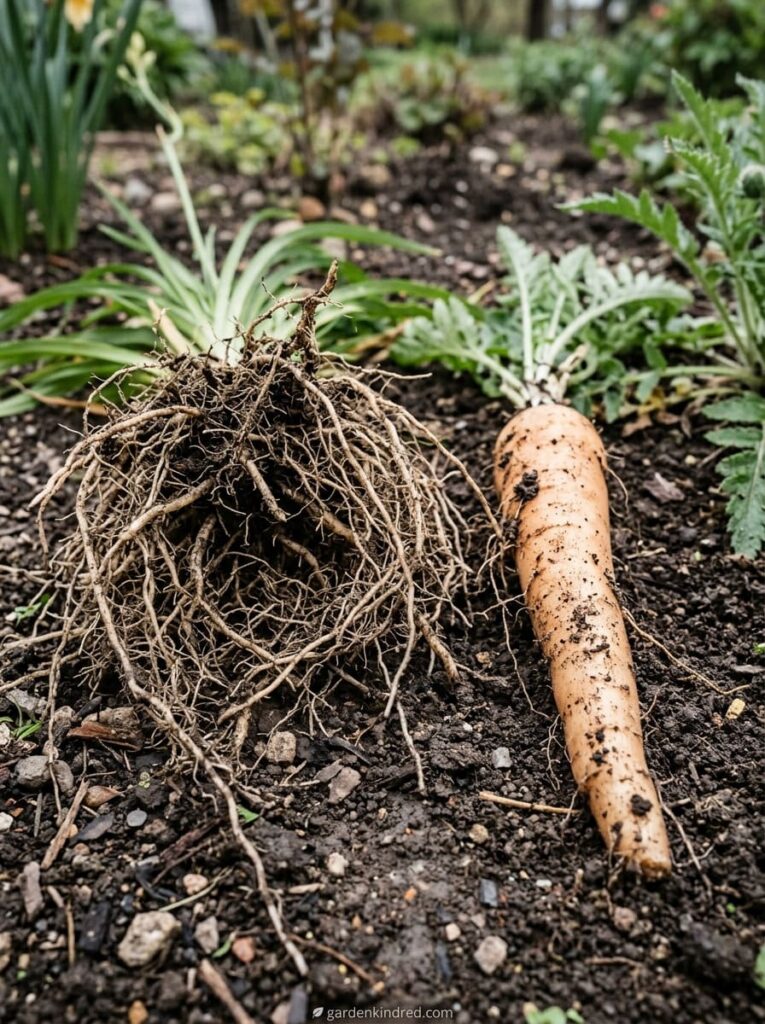
Not every perennial has a genuine, uncomplicated division point. Some have fibrous root mats that split cleanly into a dozen viable pieces. Others are built around a single taproot with nothing to divide at all, and cutting into one doesn’t create two plants, it creates two dying halves.
Good fall division candidates, per Piedmont Master Gardeners and university extension guidance:
| Plant | Root type | Why fall division works |
|---|---|---|
| Peony | Fleshy tuberous crown | Next year’s buds are already set and dormant by fall, so cutting doesn’t sacrifice next year’s bloom |
| Hosta | Fibrous clump | Tolerant of disturbance, splits cleanly with a spade or hori hori |
| Daylily | Fibrous, fan-based | Fast to re-establish, one of the most forgiving perennials to divide |
| Bearded iris | Shallow rhizome | Actually prefers a mid-to-late summer/early fall window, gets crowded and stops blooming if left too long |
| Siberian iris | Fibrous, dense | Handles fall division well once flowering is done |
| Shasta daisy | Fibrous clump | Rejuvenates bloom quality, older centers die out if never divided |
| Coral bells (heuchera) | Fibrous, woody crown | Benefits from division as the crown migrates upward with age |
| Ornamental grasses (cool-season) | Fibrous, dense | Early fall works if done at least 6 weeks before hard freeze |
Perennials that resent or outright reject division:
| Plant | Root type | Why division fails |
|---|---|---|
| Oriental poppy | Single fleshy taproot | No natural split point, cutting severs the only root system the plant has |
| Butterfly weed / milkweed | Deep single taproot | Nearly all energy is stored in one root, splitting kills both halves |
| Baptisia (false indigo) | Deep taproot | Extremely slow to re-establish after root disturbance of any kind |
| Japanese anemone | Fibrous but resents disturbance | Technically dividable but sulks for a full season or more afterward |
| Lavender | Woody-based, not a true clump | Woody perennials like this propagate better from cuttings than division |
| Warm-season ornamental grasses (miscanthus, pampas) | Fibrous, dense | Dormant by fall with little energy left to regrow roots before winter, spring division is safer |
The pattern across the “never divide” column is structural, not arbitrary. A plant that stores its energy in one central taproot has no redundancy, cut it and there’s no second crown to carry the other half forward. A plant with multiple fans, eyes, or rhizome segments has built-in redundancy, which is exactly what makes division possible in the first place.
What tools do you actually need before you start dividing?
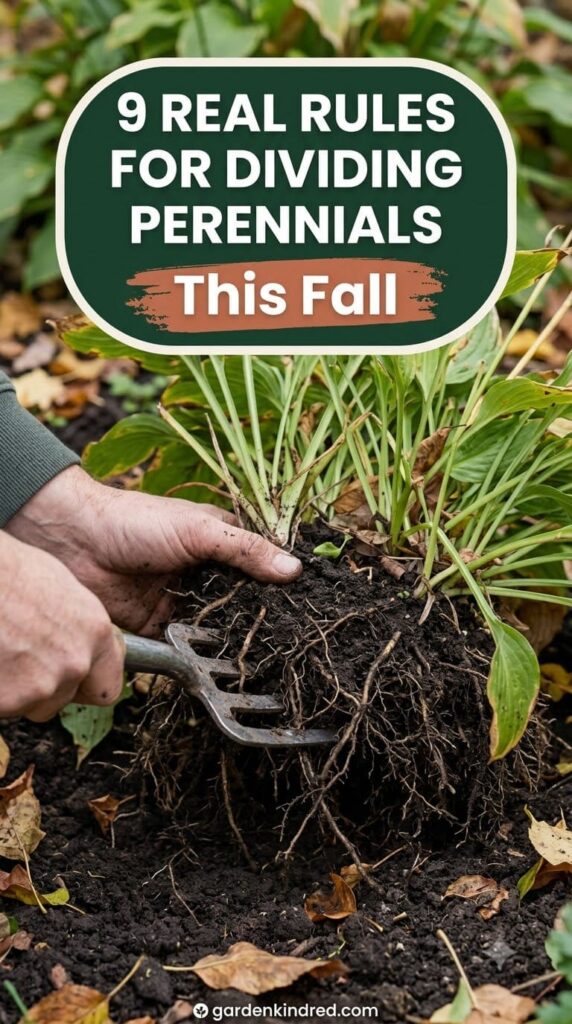
You don’t need much, but the wrong tool turns a 10-minute job into a wrecked root ball. A garden fork is the standard first tool for lifting a whole clump, its tines slide between roots instead of slicing straight through them the way a shovel does.

This is the main tool covered in the step-by-step and tool sections above. The serrated edge cuts cleanly through fibrous hosta and daylily root balls instead of tearing them, and the inch markings on the blade double as a depth gauge for the peony eye-depth rule.
Shop NowThis post contains affiliate links. We may earn a commission on qualifying purchases at no extra cost to you.
For the actual cutting, a hori hori knife handles most fibrous clumps (hosta, daylily, coral bells) and doubles as a depth gauge if the blade has inch markings. Bigger, tougher clumps, especially ornamental grasses with three or more years of growth, often need a flat spade driven straight down, or in extreme cases a small pruning saw.
For rhizomes specifically, bearded iris division calls for a clean, sharp knife rather than a fork or spade, since Clemson HGIC’s iris division guidance recommends washing soil off the rhizome clump with a hose first so you can actually see the individual rhizomes and cut between them precisely, rather than guessing at a split point through a mud-covered mass.

How do you actually dig up and divide a perennial step by step?
1. Water the clump a day or two ahead. Moist soil is dramatically easier to dig and it keeps exposed roots from drying out mid-task.
2. Cut a wide circle around the crown. Slice straight down with a spade roughly 4 to 6 inches outside the visible foliage line for a normal clump, 8 to 10 inches for anything large or overgrown, per grass-division guidance that applies across most fibrous perennials.
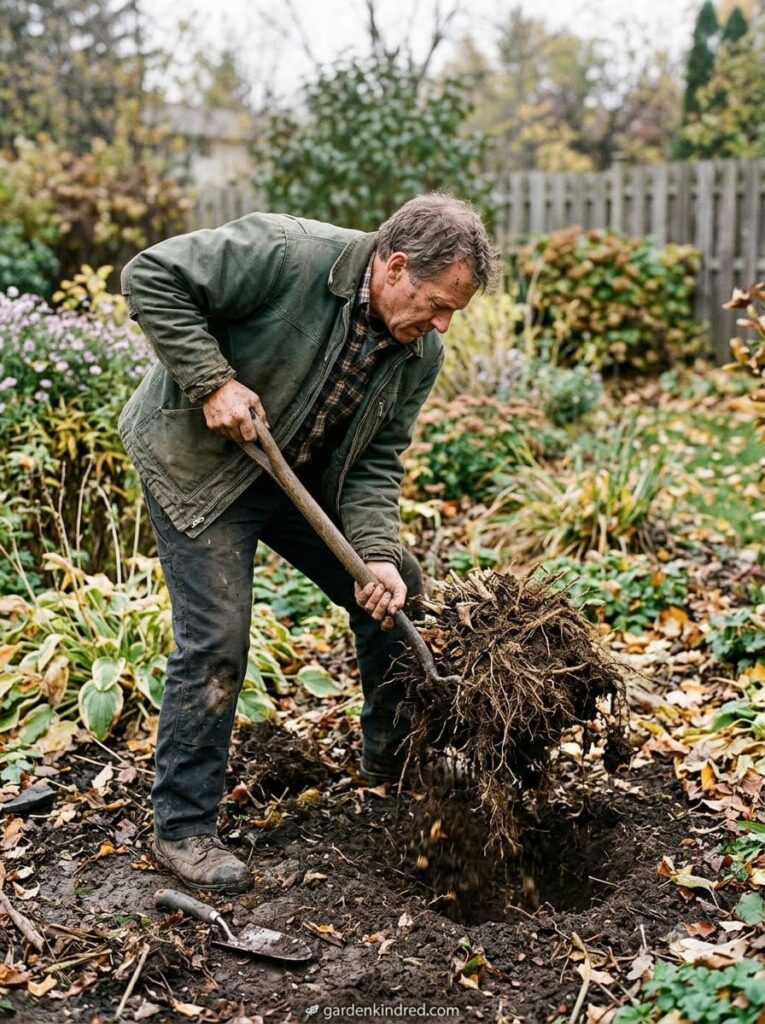
3. Lift the whole root ball. Work the fork or spade underneath and pry upward from multiple sides rather than one hard pull, which tends to snap roots you actually wanted to keep.
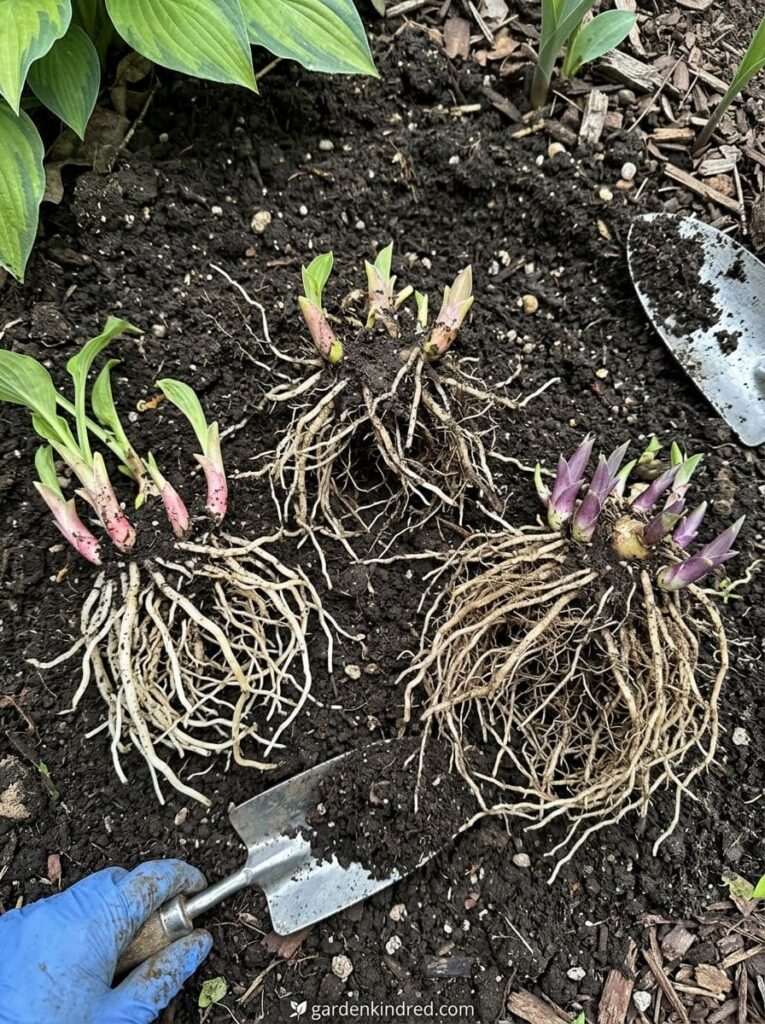
4. Shake or hose off enough soil to see what you’re working with. You need to see the crown structure, the eyes or fans, and any dead or rotted sections before you cut anything.
5. Identify real division points. Look for natural separations, fans of leaves on daylilies and iris, distinct eyes on a peony crown, individual crowns within a hosta clump. Cutting through the middle of a single growing point wastes it.
6. Cut, don’t tear. University of Vermont Extension recommends a sharp knife or spade edge over pulling clumps apart by hand, a clean cut heals faster and damages fewer adjacent roots than a ragged tear.
7. Keep 3 to 5 growing points per division, minimum. This is the number extension offices repeat most consistently. Fewer than three eyes or fans on a division commonly means a full season, sometimes two, before it blooms at normal size again.
8. Replant at the same depth it grew before, with one specific exception covered in the plant-specific section below. Firm the soil around the roots so there’s no air pocket, then water immediately.
Do hostas, irises, peonies, and ornamental grasses divide the same way?
They don’t, and treating every perennial like a generic “dig and split” job is where a lot of fall division advice falls short. The root structure dictates the technique, not the calendar.
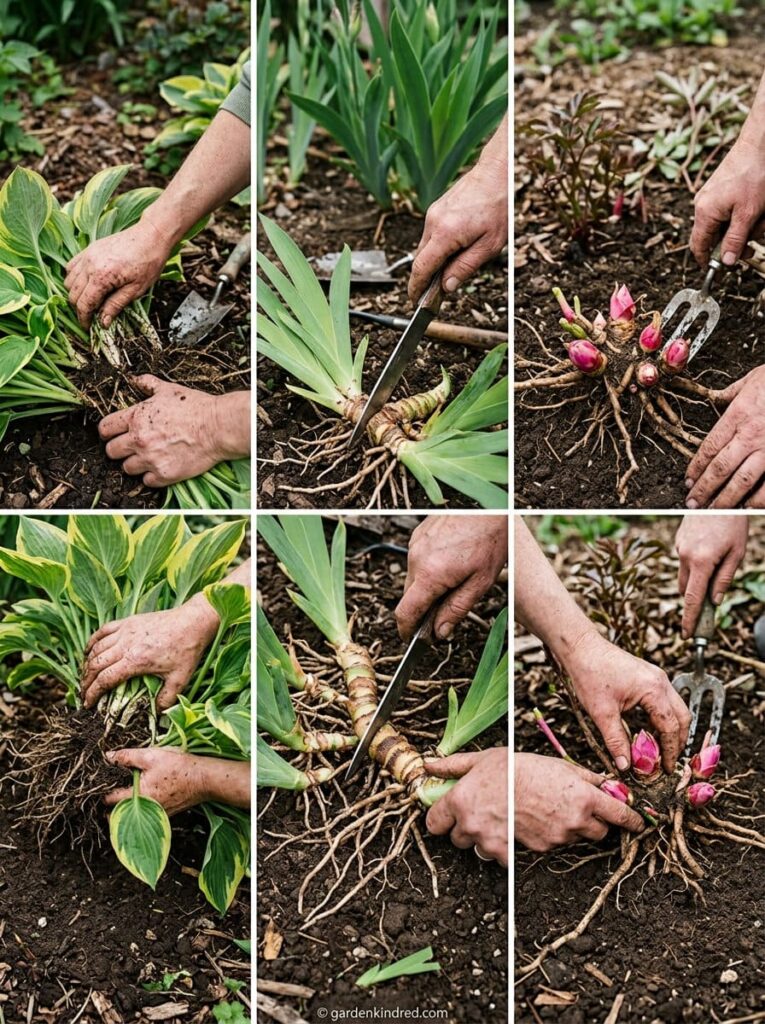
Fibrous clump division (hosta, daylily, Shasta daisy, coral bells). This is the most forgiving category. Once the root ball is lifted, a hori hori or sharp spade can cut straight through the mass, and there’s enough redundancy in a fibrous root system that even an imperfect cut usually still produces a viable division. Hostas specifically prefer spring for the mildest transition, per Iowa State University Extension’s hosta division guidance, but late summer into early fall, once peak heat has broken, is a workable second window, and a division that skips flowering for a season because the roots were disturbed still usually survives and catches up the following year.
Rhizome division (bearded iris). Iris grows from a shallow, horizontal rhizome, not a root ball you dig up whole. Illinois Extension’s bearded iris division guidance recommends trimming foliage back to about a third of its original height before dividing, which reduces water loss through the leaves while the rhizome re-roots, and each division needs a healthy fan of leaves plus a firm, undamaged section of rhizome with visible roots. Discard the old, leafless center of the clump entirely, it’s spent and won’t rebloom. Iris rhizomes also want to sit right at or barely below the soil surface when replanted, deeper planting is the single most common reason a divided iris stops blooming.
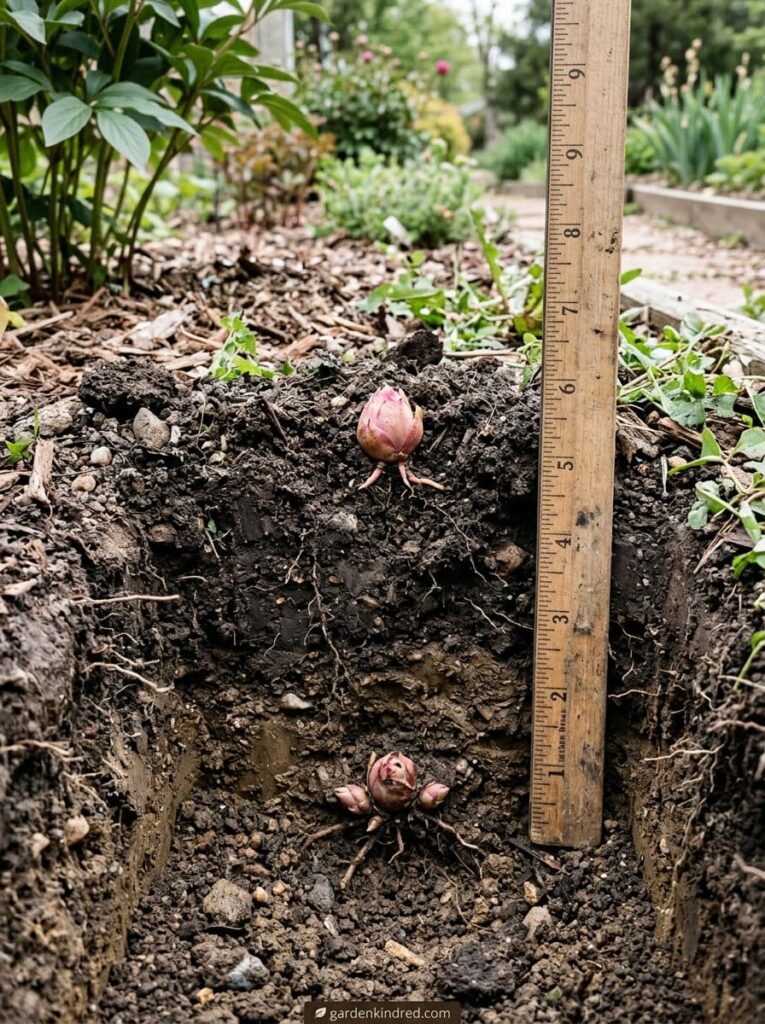
Crown/tuber division (peony). A peony crown holds distinct “eyes,” small pink or reddish buds that are next year’s growth points, not the current season’s leaves. Iowa State University Extension is specific here, each division needs at least three to five healthy eyes, since divisions with three or fewer commonly take two years to bloom again, and those eyes should sit no more than one to two inches below the soil surface when replanted. That’s noticeably shallower than most perennials, and it’s the opposite failure mode from a bulb planted too shallow, a peony eye buried too deep often just won’t bloom at all.
Ornamental grass division. Grasses don’t cut cleanly with a knife the way a hosta does, the root mass is too dense and fibrous. The standard technique is to lift the whole clump, flip it upside down so the root ball faces up, then cut through it in halves and quarters with a saw or a sharp spade, keeping each division at least 3 to 4 inches across per grass-specific extension guidance. Cool-season grasses (fescue, feather reed grass) tolerate an early fall division reasonably well if it happens at least 6 weeks before a hard freeze. Warm-season grasses (miscanthus, switchgrass, pampas) are already shutting down by fall with little energy reserve left to regrow roots, spring division is the safer call for those.
How far ahead of your first frost should you actually divide?
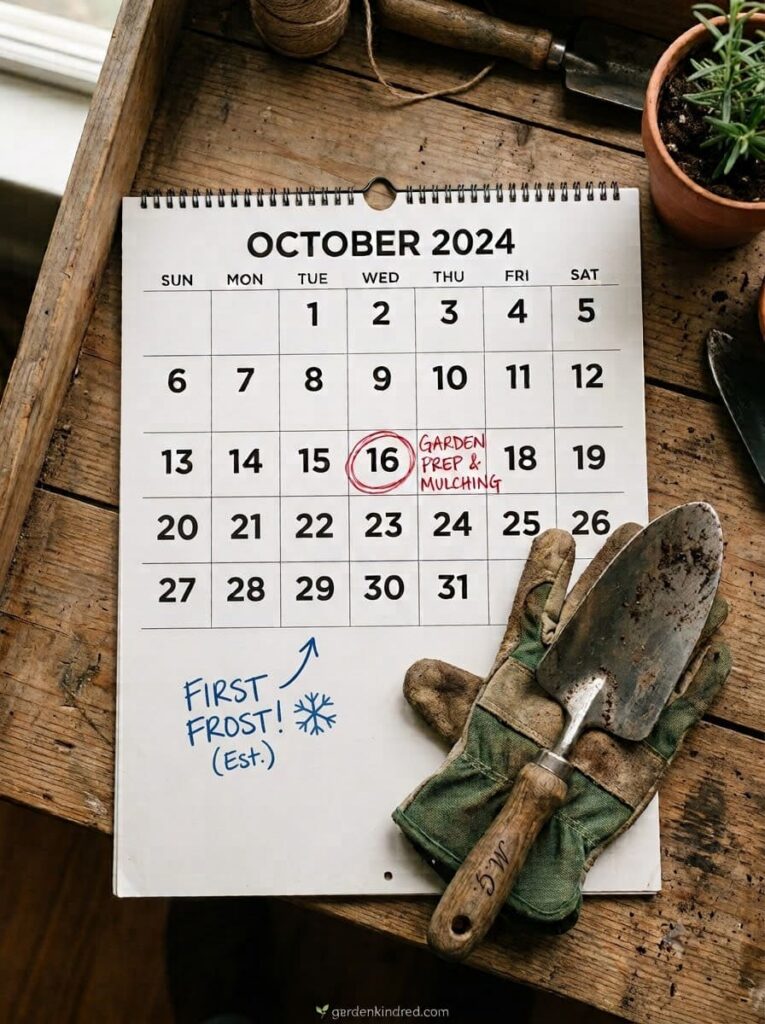
The “four to six weeks before the ground freezes” rule isn’t about the air temperature dropping, it’s about how long a severed root system needs to grow enough new root hairs to physically anchor the plant and start pulling up water before the soil locks solid.
A worked example, zone 6, one daylily clump: divided in the second week of September, roughly six weeks ahead of a typical mid-to-late October ground freeze in that zone. The division spends September and early October growing new root hairs into the surrounding soil. By the time a hard freeze arrives, the roots have enough of a hold that frost heave won’t lift the crown out of position, and the plant goes into winter dormancy with a functional, if smaller, root system already in place. Divide that same clump in late October instead, two weeks before the freeze, and there simply isn’t enough runway, the division goes into winter with roots barely started, which is when the plant is most vulnerable to being pushed up and exposed by freeze-thaw cycles.
Your exact runway depends on your actual ground-freeze date, not a fixed calendar week, which is why zone matters more than the month printed on a seed packet. For the specific week-by-week breakdown by USDA zone, including how much earlier zones 3-4 need to move versus how much later zones 7-8 can wait, see our September flower planting calendar by zone, which covers the same four-to-eight-week root establishment math applied to bulb planting alongside division timing.
How do you take care of a fresh division so it survives winter?
The division isn’t done the moment it’s back in the ground. What happens in the following few weeks determines whether it establishes or desiccates.
Water immediately and consistently. The first watering after replanting settles soil around the roots and eliminates air pockets, which matter more for a division than a mature plant since there’s no established root system yet to tolerate a dry pocket. Keep the soil consistently moist, not soggy, for the first two to three weeks.
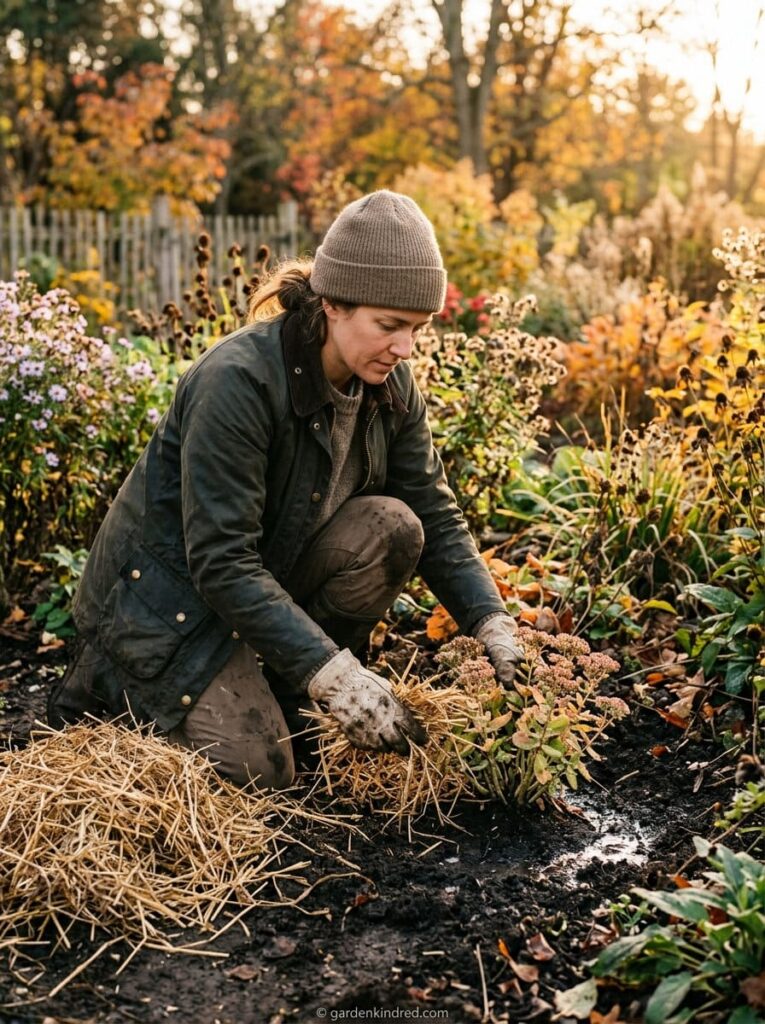
Mulch before the ground freezes, not after. A 2 to 3 inch layer of loose mulch, straw or shredded leaves work well, insulates the soil and slows the freeze-thaw cycling that drives frost heave. This matters more for a fresh division than an established plant precisely because the roots haven’t anchored deep enough yet to resist being pushed upward.
Skip fertilizer at planting time. A freshly cut root system can’t take up nutrients efficiently yet, and pushing new top growth right before dormancy wastes energy the plant needs for root recovery instead. Save fertilizing for spring, once new growth confirms the division took.
Check for heaving after the first hard freeze-thaw cycle. If a division has visibly lifted, gently press it back down and add mulch rather than replanting, disturbing the roots again this late in the season does more harm than the heaving itself.
This is task #1 on our Fall Garden Checklist. Dividing overcrowded perennials is the very first item on the list, before bulbs, before mulching, before anything else. Grab the free checklist for the other 11 tasks to do before the first frost.
What are the most common fall division mistakes?
Dividing a plant that shouldn’t be divided at all. Oriental poppy, milkweed, and baptisia get lumped into generic “divide your perennials” advice constantly, and cutting into a single taproot doesn’t create two plants, it kills the one you had. Check root type before you dig, not after.
Dividing too close to the ground freezing. Four to six weeks of root establishment isn’t optional buffer, it’s the actual mechanism that gets a division through winter. A division made two weeks before a hard freeze has a real chance of failing that one made six weeks ahead wouldn’t.
Too few eyes or fans per division. Splitting a clump into eight tiny pieces instead of three or four solid ones might feel efficient, but divisions with fewer than three growing points commonly take an extra full season to bloom at normal size, sometimes two for peonies specifically.
Planting a peony eye too deep. This is the single most common reason a divided peony fails to bloom for years afterward. One to two inches below the surface, not the deeper planting depth that works fine for most other perennial crowns.
Skipping the water-and-mulch step because the plant “looks fine.” A division doesn’t look stressed the day you plant it, the failure shows up in spring when a root system that never properly established can’t support new top growth.
Frequently asked questions
Can you divide perennials too early in fall?
Not really, dividing in early-to-mid September in most zones still leaves plenty of root-establishment time. The real risk is the opposite, dividing too late, with less than four weeks before the ground freezes.
Do all perennials need dividing eventually?
Most fibrous and rhizome perennials benefit from division every 3 to 5 years as the center of the clump gets crowded and bloom quality drops. Taprooted perennials like Oriental poppy and baptisia never need or tolerate division and should be left alone or propagated from seed instead.
What happens if a division doesn’t have enough roots?
It can still survive, but it typically spends its first full season, or longer for peonies, rebuilding root mass instead of blooming. A division with a genuinely inadequate root system (mostly stem, almost no roots) usually just fails outright.
Is it better to divide perennials in spring or fall?
It depends on the plant, not a universal rule. Peonies are fall-only because next year’s buds are already set. Hostas do best in spring but tolerate fall. Bearded iris prefers mid-to-late summer into early fall. Warm-season ornamental grasses are safer in spring.
Products We Recommend
This post contains affiliate links. We may earn a commission on qualifying purchases at no extra cost to you.
NISAKU Hori Hori Weeding and Digging Knife, 7.25-Inch Blade
This is the main tool covered in the step-by-step and tool sections above. The serrated edge cuts cleanly through fibrous hosta and daylily root balls instead of tearing them, and the inch markings on the blade double as a depth gauge for the peony eye-depth rule.
Shop Now
Spear & Jackson 1684NB Neverbend Carbon Steel Border Fork
The lifting step in this guide specifically calls for a fork over a shovel, since the tines slide between roots instead of slicing through them. This is a genuine border fork sized for garden bed work, not a full-size digging fork, which matches the scale of most perennial clumps covered above.
Shop now
Corona FL 3470 Compound Action Bypass Lopper with Extendable Handles
Useful for cutting back the dense old growth on ornamental grasses before the root ball is even visible, and for trimming iris foliage down to a third of its height before dividing. The 1.5-inch cut capacity handles woodier grass crowns that a hand pruner struggles with.
Shop nowNever miss an update — choose Garden Kindred as your preferred source on Google.
How it works: Tap the button below to open Google's settings page, then check the box next to Garden Kindred.
Tap the checkbox to turn it blue — that's how you know it's set.