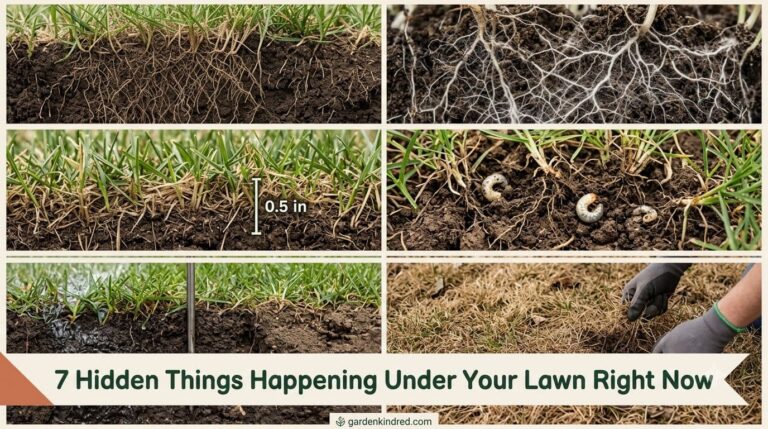
Pre-Emergent vs. Post-Emergent Weed Killer: The Real Fall Timing Answer for Clay Soil Lawns (Soil-Temperature Math Included)
Your soil thermometer knows something the calendar doesn’t. Clay lawns warm on their own schedule, and guessing the date instead of testing it is how fall weed control quietly fails.
Never miss an update — choose Garden Kindred as your preferred source on Google.
How it works: Tap the button below to open Google’s settings page, then check the box next to Garden Kindred.
Tap the checkbox to turn it blue — that’s how you know it’s set.
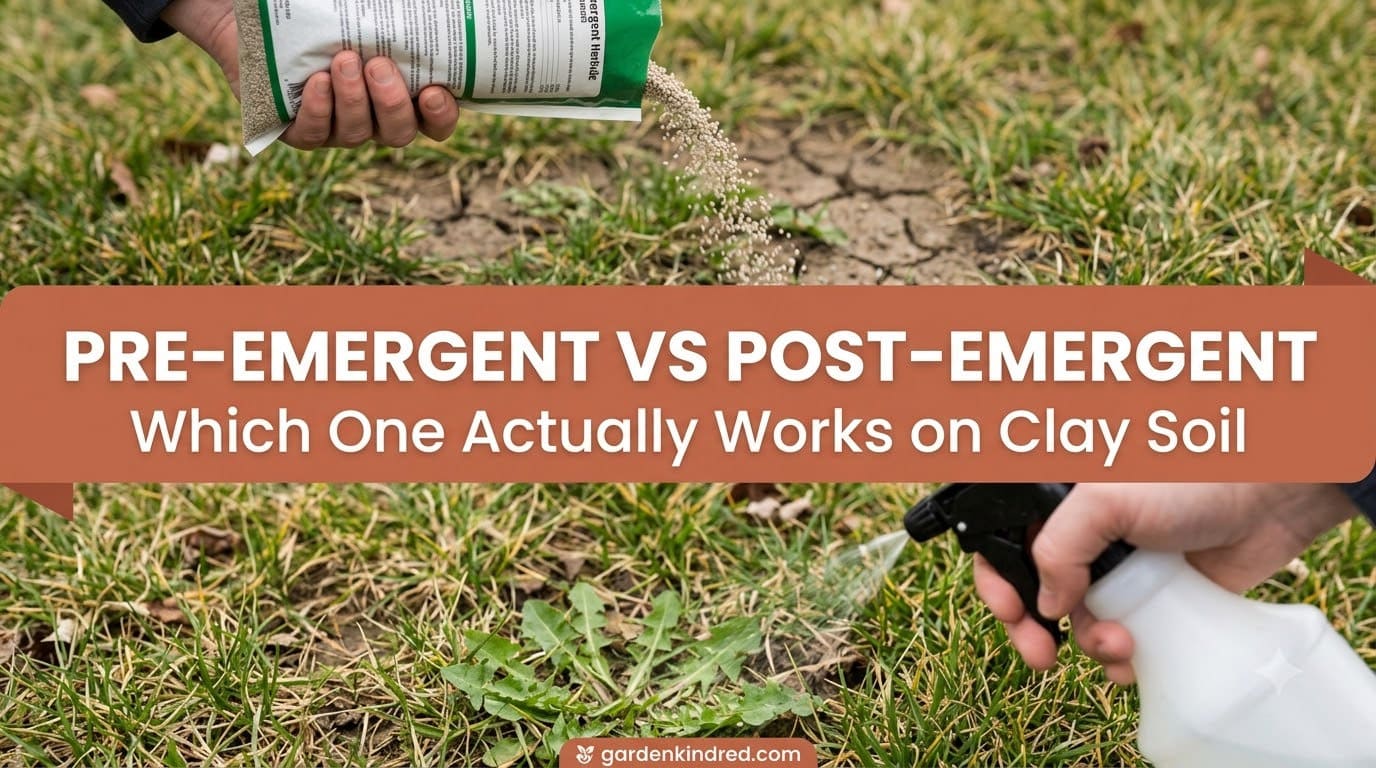
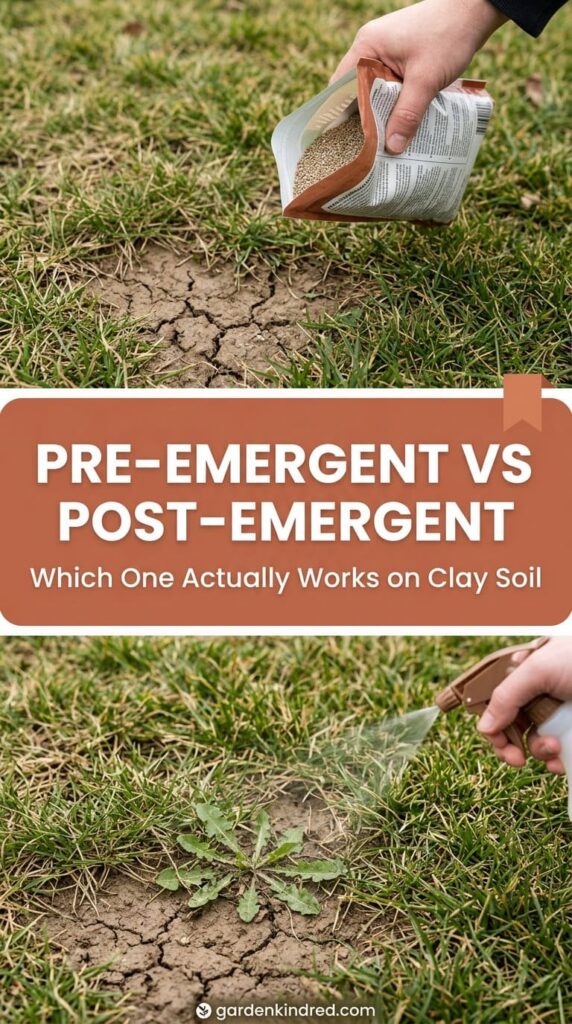
Pre-emergent herbicide (prodiamine or dithiopyr) stops weed seeds from germinating and does nothing to weeds already growing. Post-emergent herbicide (2,4-D, dicamba, MCPP, or triclopyr blends) kills weeds that are already up. In fall, most lawns need both: a post-emergent pass on any henbit or chickweed rosettes already visible, then a pre-emergent barrier for the rest of the germination window. Clay soil changes the math because it warms and cools slower than sandy soil, so a calendar date is the wrong trigger, a soil thermometer reading is the right one. Clay also binds herbicide molecules more tightly, so activation needs the higher end of the label’s water range, and compacted clay can push watering-in toward runoff instead of infiltration. Apply pre-emergent when soil hits about 70°F at 2 inches deep, watch for henbit, chickweed, and annual bluegrass, and skip aeration until after the herbicide’s residual window closes.
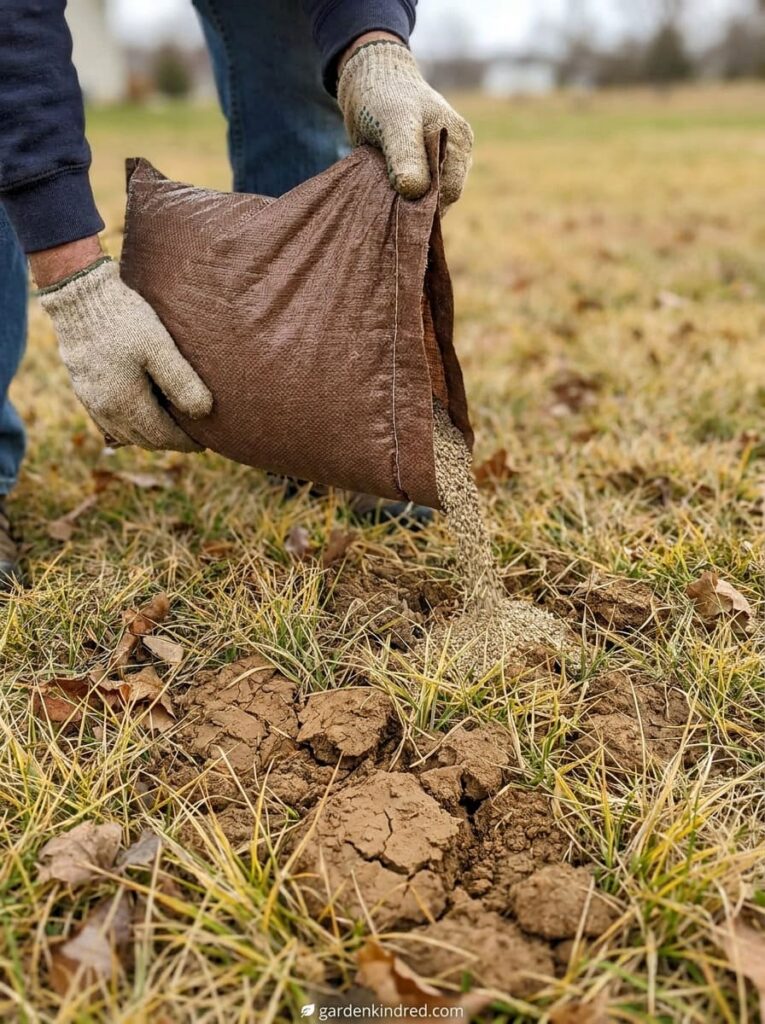
Fall is when most cool-season lawns either win or lose the winter weed fight, and clay soil is where a lot of that fight gets lost on timing alone. If you’ve got a yard that turns to concrete in August and soup in a rainstorm, you already know your soil doesn’t behave like the bag of fertilizer’s instructions assume it does.
This guide breaks down what pre-emergent and post-emergent herbicides actually do at the chemical level, why clay soil specifically throws off the timing most articles give you, and how to build a real decision framework instead of guessing.
What does pre-emergent weed killer actually do to a weed seed?
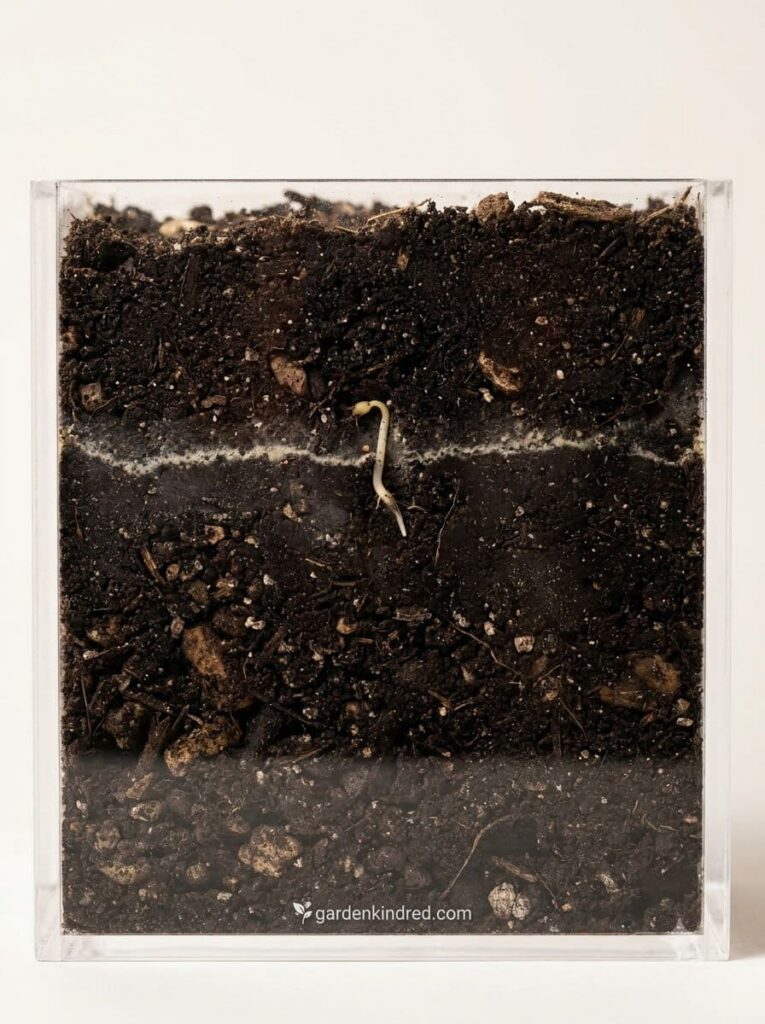
Pre-emergent herbicides like prodiamine and dithiopyr are mitotic inhibitors. That’s the actual mechanism, not marketing language: they block cell division in a germinating seedling’s root tip right as it tries to push through the soil.
The herbicide sits in the top half-inch of soil as a chemical layer. When a weed seed germinates underneath it, the emerging root hits that layer and can’t complete cell division, so the seedling dies before it ever breaks the surface.

That’s also why pre-emergent is completely useless on a weed that’s already growing. It has no way to enter established root or leaf tissue, and it was never designed to. If you can already see henbit or chickweed rosettes in your yard, spreading more pre-emergent over them does nothing but waste product and money.
The Andersons’ own label for its prodiamine product spells this out plainly: designed to prevent weeds, will not aid in eliminating existing weeds. That’s not a caveat buried in fine print, it’s the entire mechanism in one sentence.
What does post-emergent weed killer actually do to a growing weed?
Post-emergent herbicides work the opposite way. Products built on 2,4-D, dicamba, MCPP, or triclopyr are absorbed through the weed’s leaf surface and then move through the plant’s phloem, the same internal plumbing the weed uses to move its own sugars around.
Once inside, these compounds mimic the plant hormone auxin and send growth signals into overdrive. The weed’s cells start dividing and elongating in ways that have nothing to do with normal growth, and within days the plant essentially grows itself to death.
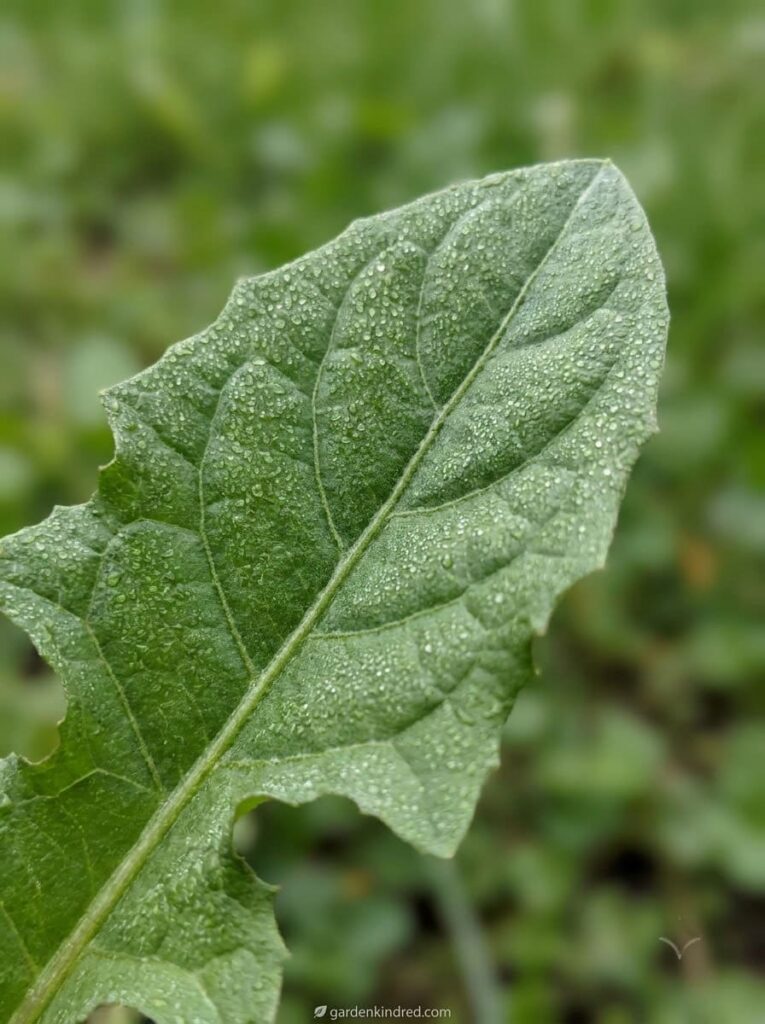
Grasses tolerate these same chemicals because of how they metabolize synthetic auxins differently than broadleaf plants do, which is the whole reason a “selective” broadleaf killer can be sprayed over turf without wiping out the lawn underneath it. Triclopyr in particular reaches weeds that 2,4-D alone struggles with, including ground ivy, violets, and wood sorrel, all common in fall lawns.
None of this works on a seed still in the ground. A post-emergent product needs actual leaf tissue to land on and absorb into, so it’s the wrong tool for the winter annuals that haven’t germinated yet.
Why does clay soil change the herbicide timing math?
Most fall weed control guides give you a calendar date, something like “apply in early September.” That advice assumes average soil behavior, and clay soil doesn’t average anything. It runs on its own clock, driven by three real mechanisms that most articles skip entirely.
Why does clay soil warm up and cool down slower than sandy soil?
Clay particles hold water in thick hydration shells around each charged particle, and that water dramatically raises the soil’s heat capacity. Research on soil thermal properties puts clay’s volumetric heat capacity in the range of 1.48 to 3.54 MJ per cubic meter per degree Celsius, compared to 1.09 to 3.04 for sand at similar moisture and density.

This is the prodiamine product referenced throughout the mechanism sections above. It targets the exact winter annuals covered in this guide, including poa annua and henbit, and its DG Technology granules are built to dissolve quickly once watered in, which matters more on clay soil where activation is already working against tighter herbicide binding.
Shop NowThis post contains affiliate links. We may earn a commission on qualifying purchases at no extra cost to you.
In plain terms, clay soil takes more energy to change temperature, so it lags behind sandy soil and behind the air temperature itself, sometimes by a week or more during fall’s temperature swings. Sandy soils warm and cool fast because they hold less water and less heat. Clay does the opposite in both directions.
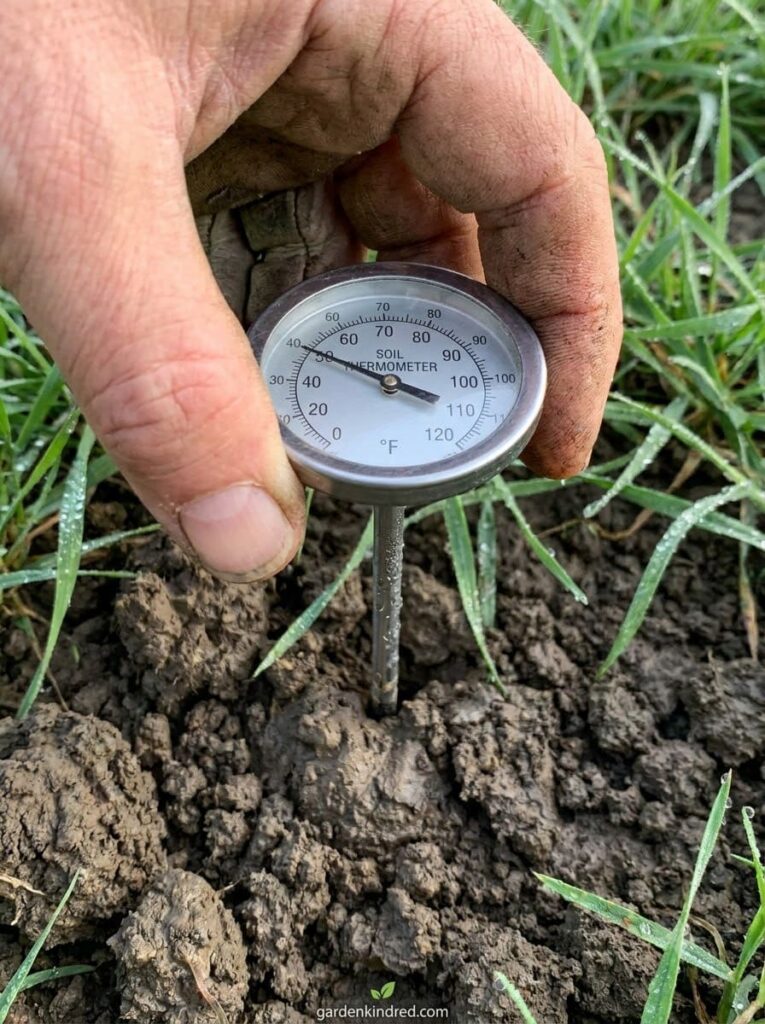
This matters because the standard fall pre-emergent trigger is a soil temperature reading, not a date. Chrissie Segars, Ph.D., a turfgrass specialist with Texas A&M AgriLife Extension, recommends applying fall pre-emergent once soil temperature at a 2-inch depth hits approximately 70°F, based on when annual bluegrass starts germinating. She’s also blunt about the calendar-date habit: “Don’t get into the habit of relying on the same calendar date every year, that’s why we have soil temperature recommendations.”
On a clay lawn, that 70°F threshold can arrive later than the same week’s date would suggest anywhere else in your neighborhood with sandier soil. A cheap soil thermometer pushed 2 inches into your own bed, not a general weather forecast, is the only way to know your actual trigger date.
Why does clay soil need more water to activate a pre-emergent, and often a higher rate?
Clay’s high cation exchange capacity, the same property behind its water-holding strength, also means it binds herbicide molecules more tightly to soil particles. University of Minnesota Extension weed scientists Sithin Mathew, Debalin Sarangi, and agronomist Tom Peters explain the practical result directly: “High CEC soils (like heavy clay or high-OM fields) can bind herbicides…and reduce their soil mobility,” which leaves “less herbicide left in the soil solution to actually kill weeds.”
That binding effect is why label rates for heavy clay soils typically sit higher than the rate listed for sandy soil, and why activation needs the upper end of the water range rather than the minimum. Most pre-emergent products want somewhere between a quarter-inch and a full inch of water within about a week of application, and on clay it pays to aim for the higher end of that range rather than skimping, since some of what you apply is getting bound up before it ever reaches a germinating seed.
Two to three sentences of watering can look identical on the surface of a clay lawn and a sandy one. What’s happening two inches down is not the same at all.
Does aerating a clay lawn undo your pre-emergent application?
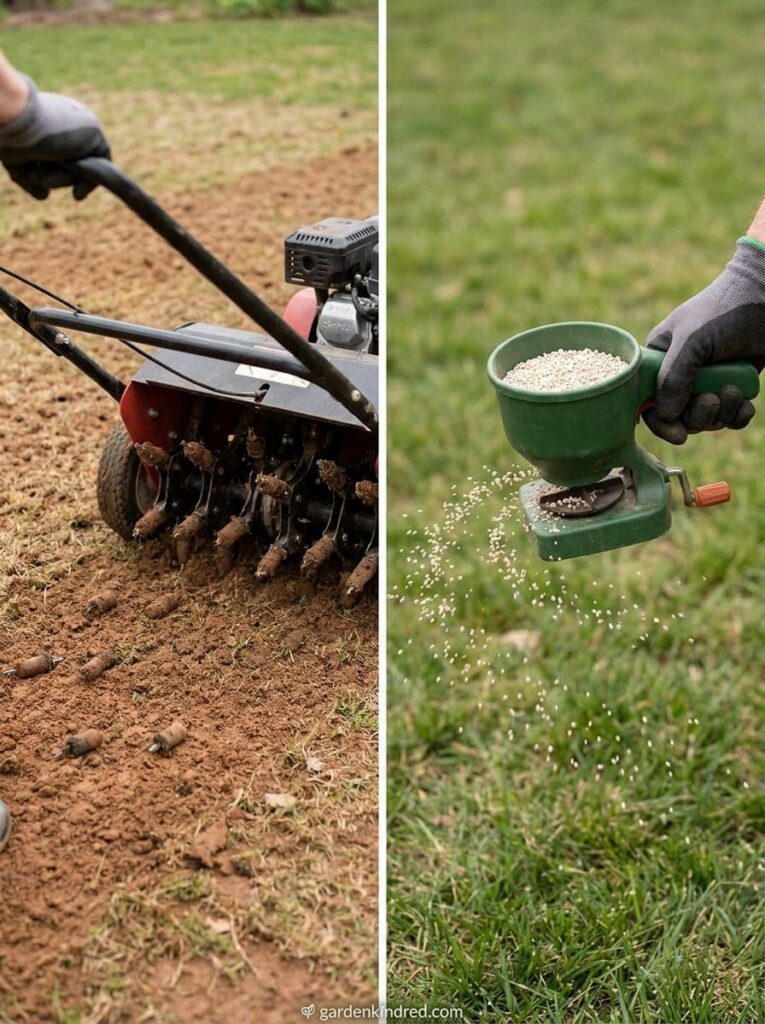
Yes, and this is the mistake that trips up more clay-soil lawns than almost anything else in the fall routine. Core aeration is genuinely useful on compacted clay, since it relieves the dense structure that chokes root growth and water infiltration in the first place. But aeration physically punches through the chemical barrier a pre-emergent herbicide creates in that top half-inch of soil.
Run a core aerator over a lawn that was treated with pre-emergent three weeks earlier, and you’ve just poked hundreds of holes straight through your weed barrier, giving any surviving seeds a clear channel to germinate right where the plug came out.
The fix is sequencing, not skipping either task. Aerate clay lawns before applying pre-emergent, or wait until the product’s labeled residual period has mostly run its course before aerating again. Compaction and weed prevention are both real problems on clay, they just can’t be solved in the wrong order.
Which weeds are actually germinating in your lawn this fall?
Fall pre-emergent isn’t a generic “weed shield,” it’s specifically timed to a group of plants called winter annuals: species that germinate in fall, spend winter as low rosettes, then flower and set seed in spring before dying off. Knowing which ones you’re actually up against changes both your timing and your product choice.
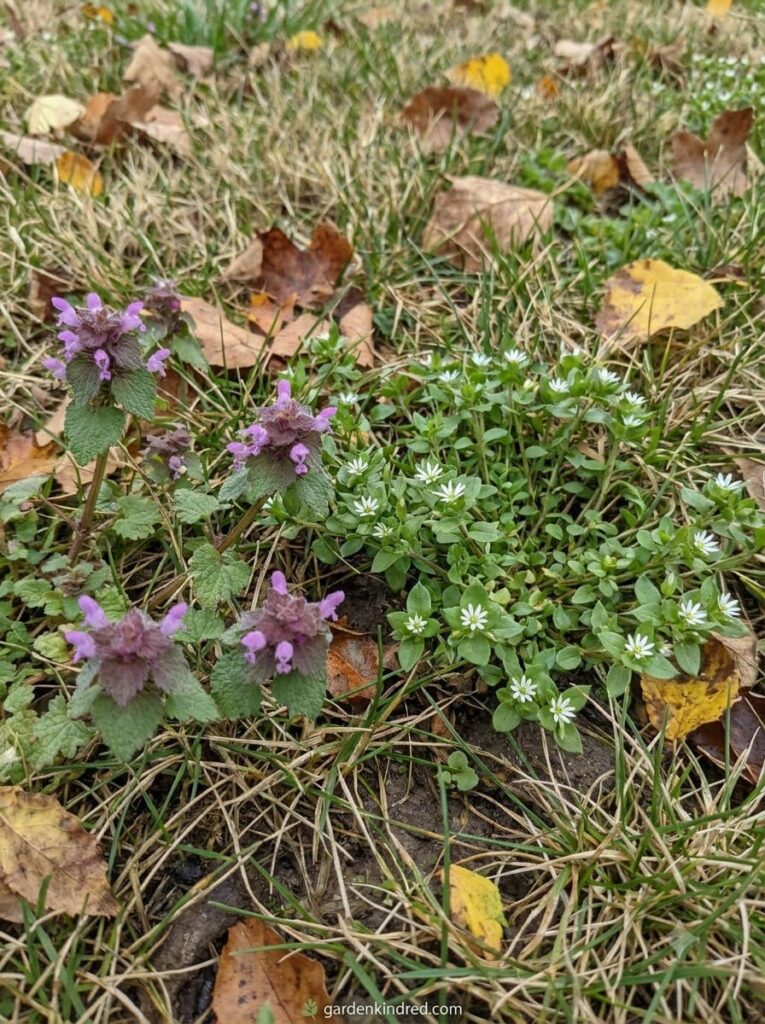
- Annual bluegrass (Poa annua): a grassy weed that germinates as soil temperatures drop through the same window a fall pre-emergent targets, then produces the light green seed heads that stick out against dormant turf all winter.
- Henbit: a square-stemmed broadleaf with scalloped leaves and small purple flowers, germinates in fall but often goes unnoticed until a warm winter stretch pushes it into visible growth.
- Chickweed: low-growing and cold-tolerant enough to survive temperatures well below freezing, common in shaded or damp parts of a clay lawn where drainage is already poor.
- Carolina geranium: a broadleaf winter annual common across the Southeast, frequently listed alongside henbit and chickweed in extension fall weed guides.
- Lawn burweed: easy to ignore in fall since it’s inconspicuous until late winter, when its spiny seed pods turn a lawn into a barefoot hazard by spring.
Two of these, henbit and chickweed, are also the two most likely to already be visibly growing by the time most homeowners think about fall weed control, which is exactly why the “which product do I need” answer usually isn’t a single product at all.
Pre-emergent or post-emergent: which one does your lawn actually need right now?
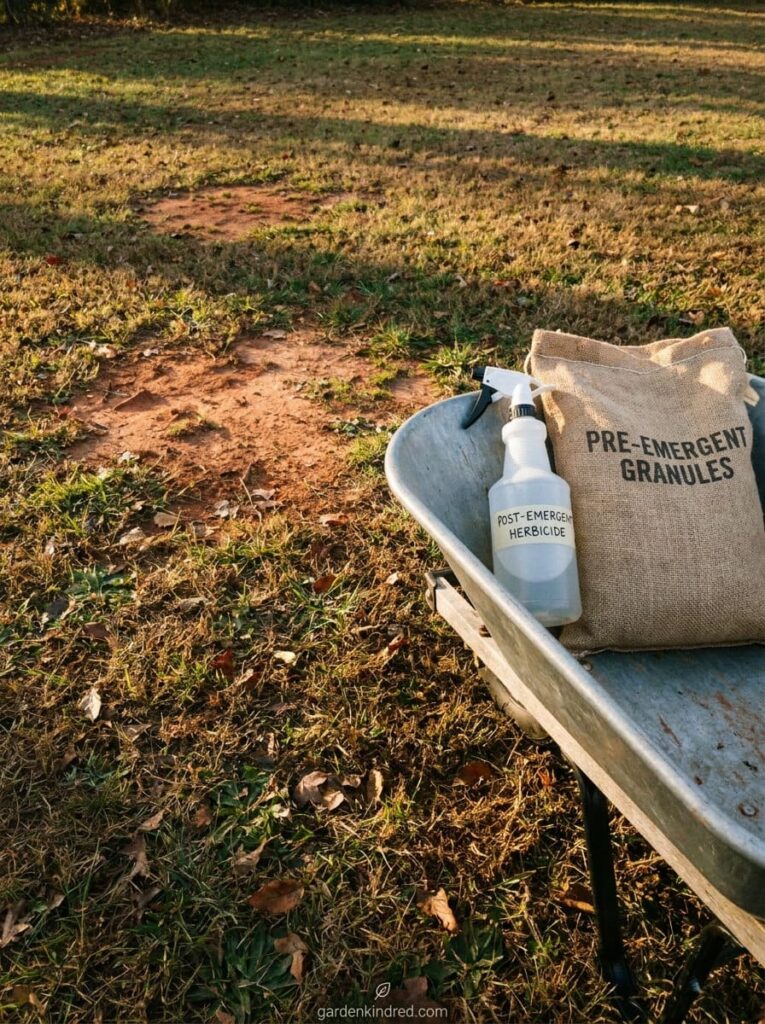
This is the actual decision, and it comes down to one question: can you already see the weed, or not?
| Situation | What to use | Why |
|---|---|---|
| Lawn looks weed-free, soil hasn’t hit your zone’s trigger temperature yet | Pre-emergent only | Nothing has germinated yet, so there’s nothing for a post-emergent to land on |
| You can already see henbit, chickweed, or other rosettes | Post-emergent first | Pre-emergent can’t touch weeds that already germinated |
| Both, which is most clay lawns by the time people notice the problem | Post-emergent on visible weeds, pre-emergent for the rest of the window | Covers what’s already up and what’s still coming |
| Lawn was aerated in the last few weeks | Post-emergent only, hold pre-emergent until after aeration settles | Aerating breaks a fresh pre-emergent barrier |
For most clay-soil lawns, the honest answer is both products, applied a few days apart rather than mixed in the same pass, since some pre-emergent labels warn against tank-mixing with certain post-emergent actives. Check your specific product labels before combining anything in one sprayer.
If you’re starting from a truly clean lawn and catching the soil-temperature window early, pre-emergent alone can carry you through most of winter. That’s the ideal case, and clay’s slower warmup gives you a slightly wider margin to catch that window than a fast-draining sandy lawn would.
How deep should you water in a pre-emergent on clay soil, and how much?
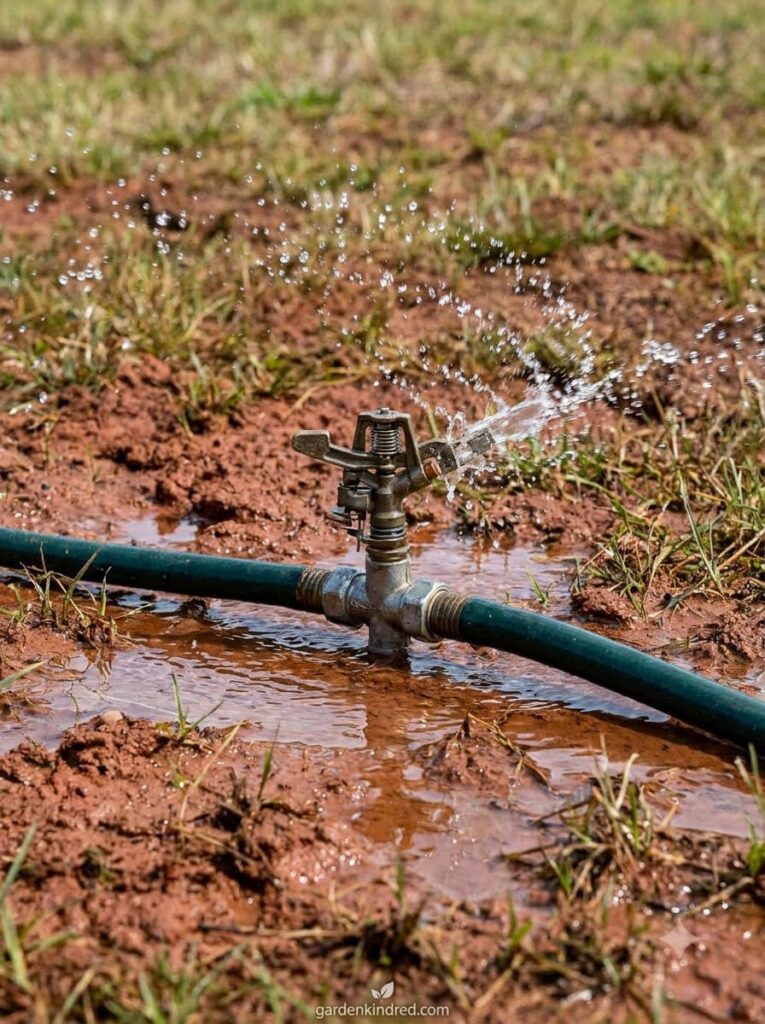
The target zone for a pre-emergent barrier is the top half-inch of soil, no deeper. Water too little and the granules or spray never dissolve into the soil solution where germinating seeds actually encounter them. Water too much, especially on compacted clay, and you risk pushing the product below the germination zone or losing it to runoff entirely on a sloped yard.
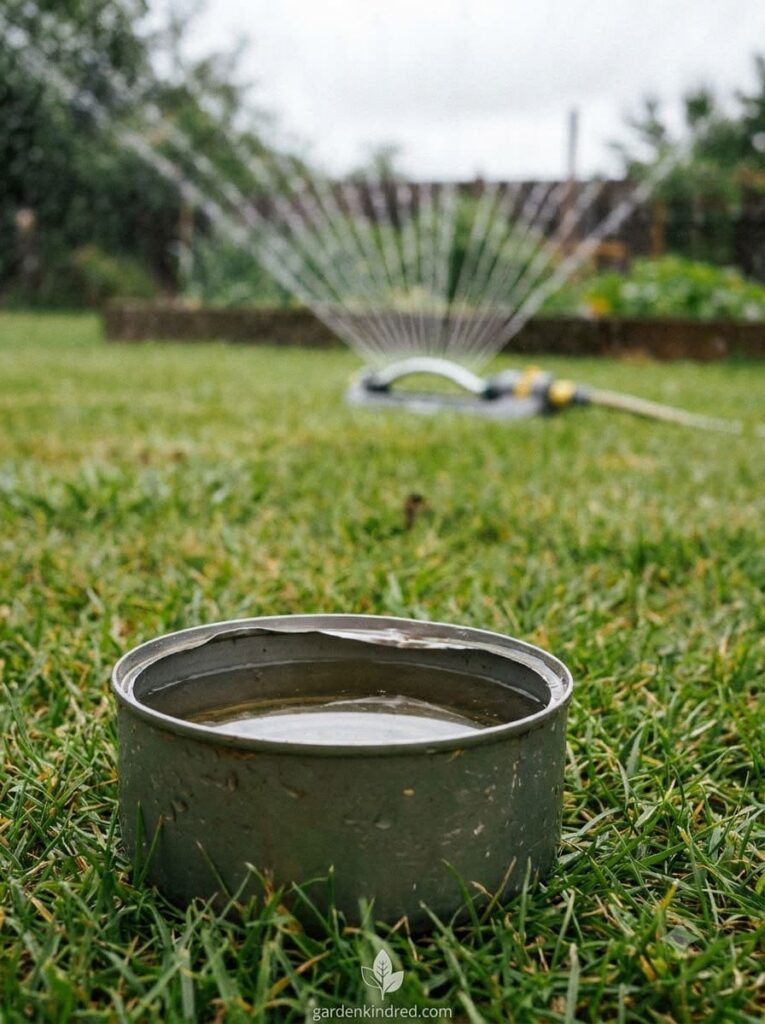
Most labels call for a quarter-inch to a half-inch of irrigation within 48 hours to a week of application, and clay soil should lean toward the higher end of that range given how much of the active ingredient gets bound to clay particles before it reaches a seed. A basic rain gauge or an empty tuna can set out during irrigation is a low-tech way to actually measure that quarter to half inch instead of guessing by the clock.
Compacted clay is the real risk factor here. If water is beading and running off the surface instead of soaking in within a minute or two, aerating before your next season’s application (not right after this one) will make every future watering-in pass more effective. And skip watering-in altogether during or right before a heavy rain event, since compacted clay sheds fast-moving water rather than absorbing it, which can carry granules toward storm drains instead of into the lawn.
Frequently asked questions
Can I mix pre-emergent and post-emergent herbicide in the same application?
Some combination products exist specifically for this, but many standalone pre-emergent labels warn against tank-mixing with certain post-emergent actives, since the compatibility depends on the exact formulations involved. Read both product labels before combining anything, and when in doubt, apply the post-emergent first, wait for it to dry, then follow with pre-emergent a few days later.
Will fall pre-emergent hurt grass seed if I want to overseed this fall too?
Yes, generally. Pre-emergent herbicide can’t tell the difference between a weed seed and a grass seed, so applying it will also block your new grass from germinating. If overseeding is part of your fall plan, skip the pre-emergent application that season or push it out several weeks past your seeding and establishment window, per your product’s specific label.
How long does it take to see results from post-emergent weed killer?
Visible wilting and curling on treated broadleaf weeds typically shows up within a few days, though full dieback can take one to two weeks depending on the weed species, the product, and how actively the weed was growing when treated. Cooler fall temperatures can slow this process compared to a warm spring application.
Comparison: real products for fall clay-soil weed control
| Product | Type | Active ingredient | Best for | Rating |
|---|---|---|---|---|
| The Andersons Barricade Professional-Grade Granular Pre-Emergent | Pre-emergent, granular | Prodiamine 0.48% | Full-season winter annual and crabgrass prevention on clay lawns, DG Technology granules dissolve fast when watered in | 4.4/5, 5,314 ratings |
| Scotts Halts Crabgrass & Grassy Weed Preventer | Pre-emergent, granular | Pendimethalin 1.71% | Budget-friendly alternative when prodiamine products are out of stock, same mitotic-inhibitor mechanism | 4.2/5, 9,589 ratings |
| Ortho WeedClear Weed Killer for Lawns, Refill | Post-emergent, liquid | 2,4-D-based broadleaf blend | Knocking out henbit, chickweed, dandelion, and clover already visible in the lawn before applying pre-emergent | 4.2/5, 627 ratings |
| Taylor Soil Testing Thermometer | Tool, analog soil thermometer | Not applicable | Reading actual 2-inch soil temperature on your own clay lawn instead of guessing from a calendar date | 4.4/5, 774 ratings, Amazon’s Choice |
Prices vary by region and change often, check the live listing before buying. All four products were confirmed live and purchasable via direct product-page verification.
Products We Recommend
This post contains affiliate links. We may earn a commission on qualifying purchases at no extra cost to you.
The Andersons Barricade Professional-Grade Granular Pre-Emergent Weed Control
This is the prodiamine product referenced throughout the mechanism sections above. It targets the exact winter annuals covered in this guide, including poa annua and henbit, and its DG Technology granules are built to dissolve quickly once watered in, which matters more on clay soil where activation is already working against tighter herbicide binding.
Shop Now
Ortho WeedClear Weed Killer for Lawns, Refill
The post-emergent half of the fall decision framework in this article. If you've already spotted henbit or chickweed rosettes in your yard, a pre-emergent won't touch them, this is the product built for exactly that situation, killing visible broadleaf weeds down to the root before you lay down a pre-emergent barrier for what's still germinating.
Shop Now
Taylor Soil Testing Thermometer
The single tool that fixes the calendar-date mistake this entire article is built around. A 4-inch probe reads soil temperature 2 inches down, letting you catch your lawn's real 70°F fall trigger instead of guessing based on when your neighbor with sandy soil applied theirs.
Shop NowNever miss an update — choose Garden Kindred as your preferred source on Google.
How it works: Tap the button below to open Google's settings page, then check the box next to Garden Kindred.
Tap the checkbox to turn it blue — that's how you know it's set.